
What is the significance of a placental lake?
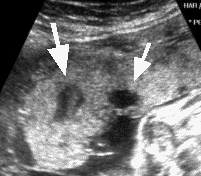 Placental lakes are enlarged spaces within the placenta filled with
maternal blood. These spaces represent normal intervillous spaces, where
maternal blood bathes the chorionic villi, allowing oxygen and nutrient exchange.
Placental lakes are enlarged spaces within the placenta filled with
maternal blood. These spaces represent normal intervillous spaces, where
maternal blood bathes the chorionic villi, allowing oxygen and nutrient exchange.
On ultrasound, placental lakes appear black or anechoic because they do not reflect sound. They may show slow swirling flow, and their shape can change with uterine contraction. These features help distinguish lakes from thrombi.
Are placental lakes normal?
Yes—most placental lakes are a normal variant and have no adverse impact on pregnancy.
When can placental lakes be associated with complications?
- Multiple lakes early (<20 weeks) have been associated with fetal growth restriction in some series.
- Large or numerous lakes with placenta previa and prior uterine surgery raise concern for placenta accreta spectrum (PAS).
- Thickened placenta + multiple cystic spaces suggests:
- Placental mesenchymal dysplasia (PMD)
- Gestational trophoblastic disease
“Lakes” vs. “Lacunae” (important modern distinction)
ISUOG guidelines distinguish:
- Lakes – smooth-walled, compressible, normal intervillous spaces.
- Lacunae – irregular, turbulent spaces seen in PAS (accreta/percreta).
Synonyms: Intervillous spaces, placental caverns, venous lakes, placental sonolucencies.
See also:
ISUOG video: Placental lakes vs lacunae — spotting key differences
References
1. Reis NS et al. Placental lakes and obstetric outcomes. J Clin Ultrasound. 2005. PMID: 15674837.
2. Thompson MO et al. Are placental lakes clinically significant? Placenta. 2002. PMID: 12361687.
3. Jauniaux E, Nicolaides KH. Placental lakes and poor fetal growth. Ultrasound Obstet Gynecol. 1996. PMID: 8776240.
4. Nayeri UA et al. Sonographic findings in placental mesenchymal dysplasia. UOG. 2013. PMID: 23239538.
5. Hudon L. Diagnosis & management of placenta percreta. Obstet Gynecol Surv. 1998. PMID: 9702791.