
Blood Pressure
Definition of blood pressure, how to read a blood pressure, and classification of blood pressure levels in adults.
Blood pressure is the force exerted by the circulating blood on the walls of the blood vessels.
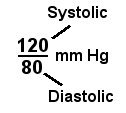
Blood pressure is recorded as two numbers:
- The top number is called the systolic blood pressure. It is the pressure in the blood vessels when the heart contracts.
- The bottom number is called the diastolic blood pressure. It is the pressure in the blood vessels when the heart relaxes.
For example, the pressure shown above would be read as “120 over 80”. Blood pressure is measured in millimeters of mercury (mm Hg).
Classification of Blood Pressure Levels in Adults
Based on systolic and diastolic measurements (mm Hg) in adults.
| Category | Systolic | Diastolic | |
|---|---|---|---|
| Normal | Less than 120 | AND | Less than 80 |
| Prehypertension | 120 to 139 | OR | 80 to 89 |
| High Blood Pressure (Hypertension) | |||
| Stage 1 | 140 to 159 | OR | 90 to 99 |
| Stage 2 | 160 or higher | OR | 100 or higher |
Elevated blood pressure readings should be documented on at least two occasions at least four hours apart.
References
- National High Blood Pressure Education Program. The Seventh Report of the Joint National Committee on Prevention, Detection, Evaluation, and Treatment of High Blood Pressure. Bethesda (MD): National Heart, Lung, and Blood Institute (US); 2004 Aug. PMID: 20821851.
- Pickering TG, et al. Recommendations for blood pressure measurement in humans and experimental animals: part 1: blood pressure measurement in humans: a statement for professionals from the Subcommittee of Professional and Public Education of the American Heart Association Council on High Blood Pressure Research. Circulation. 2005;111(5):697–716. PMID: 15699287.
- Hypertension in pregnancy: executive summary. Obstet Gynecol. 2013;122(5):1122–1131. doi:10.1097/01.AOG.0000437382.03963.88. PMID: 24150027.