Pregnancy weight gain by gestational week
Enter height, pre-pregnancy weight, gestational age, and current weight. The calculator estimates pre-pregnancy BMI, a current singleton weight range, total singleton or twin pregnancy gain, and a term target-weight range.
Results update automatically. Week-specific singleton values are counseling estimates rather than fetal-growth percentiles. Twin recommendations are displayed as total ranges because validated week-specific twin targets are not established by the cited guidelines.
Enter pregnancy information
Clinical context
Pregnancy weight tracker
Add dated weights to follow the trajectory across visits. Saved entries are plotted on the singleton graph.
| Date | Gestational age | Weight | Change | Compared with range | Action |
|---|---|---|---|---|---|
| No saved visits. | |||||
Privacy: entries are stored with localStorage in this browser and are not sent to Perinatology.com. Clearing browser data may remove them.
Singleton weight-by-week schedule
This table appears after a singleton calculation and uses the same estimated trajectory as the graph.
| Gestational age | Expected gain | Recommended weight |
|---|---|---|
| Complete the calculator to generate a schedule. | ||
Clinician details and copyable summary
Pregnancy weight-gain recommendations
Singleton pregnancy
| Pre-pregnancy BMI | Total gain | Average 2nd–3rd trimester rate |
|---|---|---|
| Underweight: <18.5 | 12.5–18 kg (28–40 lb) | 0.44–0.58 kg/week (1.0–1.3 lb/week) |
| Healthy weight: 18.5–24.9 | 11.5–16 kg (25–35 lb) | 0.35–0.50 kg/week (0.8–1.0 lb/week) |
| Overweight: 25.0–29.9 | 7–11.5 kg (15–25 lb) | 0.23–0.33 kg/week (0.5–0.7 lb/week) |
| Obesity: ≥30 | 5–9 kg (11–20 lb) | 0.17–0.27 kg/week (0.4–0.6 lb/week) |
Twin pregnancy
| Pre-pregnancy BMI | Total gain | Evidence note |
|---|---|---|
| Underweight: <18.5 | 22.7–28.1 kg (50–62 lb) | CDC recommendation; this is the exception to the IOM-derived ranges. |
| Healthy weight: 18.5–24.9 | 16.8–24.5 kg (37–54 lb) | Provisional IOM range at term. |
| Overweight: 25.0–29.9 | 14.1–22.7 kg (31–50 lb) | Provisional IOM range at term. |
| Obesity: ≥30 | 11.3–19.1 kg (25–42 lb) | Provisional IOM range; not stratified by obesity class. |
The cited twin recommendations are total ranges at term. This calculator intentionally does not classify twin gain as below, within, or above a week-specific range.
How the estimate is calculated
Pre-pregnancy BMI: weight in kilograms divided by height in meters squared. The BMI category determines the guideline range.
Singleton first trimester: the National Academies calculations assume a total first-trimester gain of 0.5–2 kg (1.1–4.4 lb). For display by week, this calculator interpolates from zero at conception to that range at 13 completed weeks.
Singleton after 13 weeks: the calculator interpolates from the first-trimester range at 13 weeks to the published total range at 40 weeks. This produces a smooth counseling trajectory that reaches the guideline total at term; published weekly rates are rounded and may not reproduce the total endpoints exactly.
Recommended current weight: pre-pregnancy weight plus the calculated gain range at the entered gestational age.
Twin pregnancy: only the total recommended gain and target term weight are calculated. No linear or proportional week-specific twin adequacy standard is applied.
Important limitation: the result is a counseling estimate. Weight measurement error, uncertain baseline weight, first-trimester weight loss, edema, fetal growth, maternal illness, nutrition, and other clinical factors can change interpretation.
Common questions
What if pre-pregnancy weight is uncertain?
Use the best documented weight close to conception and select the estimated-baseline checkbox. Interpret a narrow difference from the displayed range cautiously.
What if weight was lost in the first trimester?
The calculator reports net change from pre-pregnancy weight. Nausea, vomiting, hydration, nutritional intake, and fetal growth should be considered rather than treating the displayed range as an isolated treatment target.
Does rapid weight gain diagnose preeclampsia?
No. Rapid gain may reflect fluid retention, but it does not diagnose a hypertensive disorder. Symptoms, blood pressure, examination, and appropriate laboratory evaluation determine clinical assessment.
Can this be used for triplets?
No. Triplet and higher-order pregnancies require individualized guidance because the cited tables do not provide applicable recommendations.
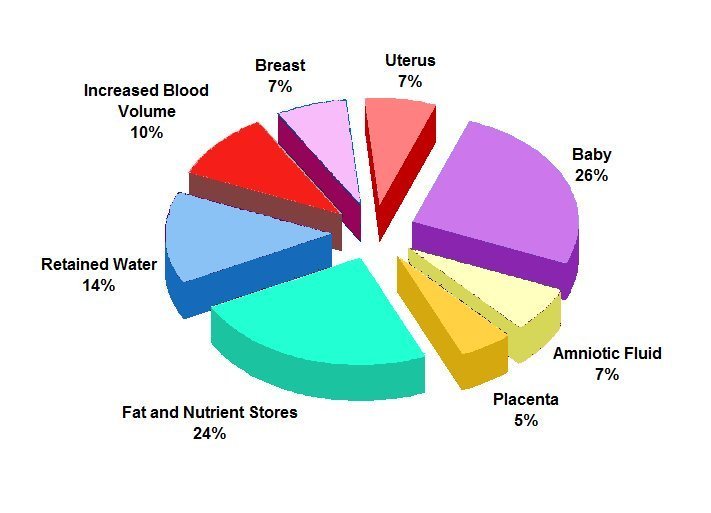
Where does pregnancy weight gain go?
Pregnancy weight includes the fetus, placenta, amniotic fluid, larger uterus and breasts, expanded blood volume and body water, and maternal fat and nutrient stores. The proportions vary among individuals.
References
- Institute of Medicine and National Research Council. Weight Gain During Pregnancy: Reexamining the Guidelines. Washington, DC: National Academies Press; 2009. National Academies report.
- Centers for Disease Control and Prevention. Weight Gain During Pregnancy. Updated May 15, 2024. CDC pregnancy weight guidance.
- American College of Obstetricians and Gynecologists. Committee Opinion No. 548: Weight Gain During Pregnancy. Obstet Gynecol. 2013;121:210–212. ACOG guidance.
- Rasmussen KM, Catalano PM, Yaktine AL. New guidelines for weight gain during pregnancy: what obstetrician/gynecologists should know. Curr Opin Obstet Gynecol. 2009;21:521–526. Full text.
Disclaimer: All calculations should be confirmed before clinical use. This tool supports education and counseling and does not replace individualized clinical judgment.