
Umbilical Artery Doppler Reference Ranges -with percentiles
This calculator provides gestational age-specific reference values for commonly used umbilical artery (UA) impedance indices (S/D ratio, resistance index (RI), and pulsatility index (PI)). You can also enter an observed value to estimate its percentile for gestational age and its MoM (multiple of the median = observed ÷ 50th percentile).
Umbilical artery impedance indices are calculated by measuring Doppler waveforms from the umbilical arteries in a free-floating portion of the cord.
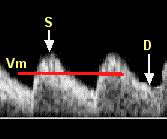
S = systolic peak (maximum velocity); D = end-diastolic flow; Vm = mean velocity.
The ratios (indices) of resistance to blood flow (impedance) are calculated as:
S/D ratio = systolic velocity ÷ diastolic velocity
Resistance index (RI) = (systolic - diastolic) ÷ systolic
Pulsatility index (PI) = (systolic - diastolic) ÷ mean velocity
- Acharya (2005): The paper reports week-specific percentile values (2.5th-97.5th) for each index. For a gestational age with days (eg, 31+4), the calculator linearly interpolates between adjacent completed weeks on each percentile curve. An observed measurement is assigned a percentile by finding which two percentile curves it falls between (at that gestational age) and interpolating between them.
- INTERGROWTH-21st (Drukker 2020): The paper provides equations for model parameters (λ, μ, σ). The calculator computes a z score from the observed value using the published formula and converts it to a percentile (Φ(z)×100). Expected 50th and 95th values are computed from the same model (z=0 and z=1.64485). (The z score is displayed only when INTERGROWTH is selected.)
Calculator
Choose reference source, then enter GA as weeks + days.
References
- Gosling RG, et al. The quantitative analysis of occlusive peripheral arterial disease by non-intrusive ultrasound technique. Angiology. 1971;22:52-5. PMID:5101050
- Acharya G, Wilsgaard T, Berntsen GKR, Maltau JM, Kiserud T. Reference ranges for serial measurements of umbilical artery Doppler indices in the second half of pregnancy. Am J Obstet Gynecol. 2005;192:937-44. PMID:15746695
- Drukker L, Staines-Urias E, Villar J, et al. International gestational age-specific centiles for umbilical artery Doppler indices: a longitudinal prospective cohort study of the INTERGROWTH-21st Project. Am J Obstet Gynecol. 2020;222(6):602. PMID:31954701 | Full text (PMC)
- Society for Maternal-Fetal Medicine; Martins JG, Biggio JR, Abuhamad A. SMFM Consult Series #52: Diagnosis and management of fetal growth restriction. Am J Obstet Gynecol. 2020;223(4):B2-B17. PMID:32407785 | SMFM summary