
Rh Disease and Red Cell Alloimmunization in Pregnancy
Background and pathogenesis
Maternal red-cell alloimmunization occurs when a patient is exposed to fetal or transfused red blood cells carrying an antigen they lack. The maternal immune response produces IgG antibodies. If the fetus inherits the corresponding antigen, maternal IgG can cross the placenta and cause hemolytic disease of the fetus and newborn (HDFN).
The fetal consequences are progressive: hemolysis and/or impaired erythropoiesis, fetal anemia, high-output cardiac failure, hydrops fetalis, stillbirth, neonatal anemia, and hyperbilirubinemia. Anti-D remains the classic cause, but anti-c, anti-E, Kell and other antibodies are clinically important. Kell is distinctive because it can suppress fetal erythropoiesis, so anemia may be severe even when bilirubin-based historical tests or titers appear less impressive.
Core workflow
Identify the antibody. Confirm specificity, determine whether it is clinically significant for HDFN, obtain a baseline titer if titers are useful for that antibody, and use the same laboratory for serial titers.
Determine fetal antigen risk. If paternity is certain, paternal antigen testing and zygosity may define risk. If the father is antigen-negative, the fetus is not at risk. If paternal status is heterozygous, unknown, unavailable, or paternity is uncertain, use cell-free fetal DNA when available or diagnostic testing when clinically justified.
Choose the surveillance pathway. A first at-risk pregnancy with titers below the critical threshold can usually be followed by titers. A prior affected pregnancy, Kell disease meeting threshold, hydrops, or a critical titer in an antigen-positive/unknown fetus moves to MCA-PSV surveillance.
Use MCA-PSV correctly. Measure near the MCA origin with the smallest possible angle. MCA-PSV ≥1.5 MoM suggests significant anemia, but interpretation must consider gestational age, trend, fetal activity, hydrops, prior IUT, and technical quality.
Refer before hydrops if possible. When severe anemia is suspected and delivery is not the safer option, fetal blood sampling should be performed at a center prepared to transfuse immediately.
Management Flowchart for Alloimmunization
Printable graphic flowchart: red-cell alloimmunization in pregnancy
Clinically significant red-cell antibody identified or suspected.
Review prior pregnancy history, transfusion history, and whether the antibody is known to cause HDFN.
Usually significant: anti-D, anti-c, anti-C, anti-E, anti-Kell, anti-Fya, anti-Jka, and selected others.
Usually not significant for HDFN: Lewis and I.
Give RhIg prophylaxis if the patient is unsensitized RhD-negative and prophylaxis is indicated.
Use paternal antigen testing/zygosity when appropriate. Use cell-free fetal DNA after 10 weeks for RhD, RhC, Rhc, RhE, Kell, and Fya when available. Use invasive fetal genotyping only when needed.
Continue routine obstetric care.
Prior fetal anemia, hydrops, IUT, exchange transfusion, or perinatal loss from HDFN.
Refer to MFM/fetal therapy. Begin MCA-PSV surveillance at 16-18 weeks, often weekly.
Typical threshold for most antibodies is about 1:16, but this is laboratory-specific; many centers use 1:8-1:32. Anti-Kell has a lower threshold, often 1:4.
Primary modern noninvasive screen for moderate to severe fetal anemia. Usually weekly once indicated. Use trend and clinical context. Interpret cautiously after 34-35 weeks because false-positive results increase.
Confirm fetal hematocrit/hemoglobin as needed. Perform IUT when appropriate. Plan repeat IUTs based on MCA-PSV, gestational age, and expected decline in fetal hemoglobin.
If stable, many pregnancies are delivered at 37-38 weeks. Deliver earlier for worsening anemia, hydrops, nonreassuring fetal status, or obstetric indications. Prepare neonatal team for anemia, hyperbilirubinemia, phototherapy, and possible exchange transfusion.
A) Prevention pearls
- RhIg is for unsensitized RhD-negative patients only.
- Give after sensitizing events, at 28 weeks, and postpartum if infant is Rh-positive or Rh-unknown.
- Sensitizing events include miscarriage/abortion, ectopic pregnancy, bleeding, CVS, amniocentesis, trauma, and external cephalic version.
- Weak D or discrepant RhD: consider RhD genotyping; if uncertain, manage conservatively as RhD-negative until clarified.
B) When to refer for IUT
- MCA-PSV ≥1.5 MoM.
- Hydrops or ultrasound evidence of severe anemia.
- Rapidly rising MCA-PSV.
- Previously affected pregnancy with early severe disease.
- Need for fetal blood sampling or specialized fetal therapy.
C) Historical note
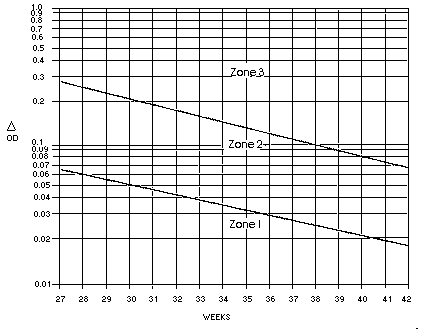
- Amniotic-fluid ΔOD450 / Liley curve is historical and has largely been replaced by MCA-PSV.
- Liley Zone I: mild/no disease; follow about every 3 weeks.
- Low Zone II: follow every 1-2 weeks.
- Upper/mid Zone II: may require transfusion or delivery depending on gestational age.
- Zone III: severe disease; deliver or perform IUT depending on gestational age.
Clinically important antibodies
| Antibody group | Clinical relevance | Management implication |
|---|---|---|
| RhD | Classic and highly antigenic cause of HDFN. | If fetus is antigen-positive/unknown, follow titers until critical threshold unless prior affected pregnancy. |
| Rh non-D: anti-c, anti-C, anti-E, anti-e | Can cause clinically significant HDFN. Anti-c is particularly important. | Manage similarly to anti-D when clinically significant and fetus is antigen-positive/unknown. |
| Kell: anti-K / K1 | Can cause severe anemia by hemolysis and suppression of erythropoiesis; titers and ΔOD450 may correlate poorly. | Lower threshold for action. Begin MCA-PSV when Kell titer is ≥1:4 or there is a prior affected fetus/neonate. |
| Duffy and Kidd | Can cause HDFN, although severity varies. | Confirm fetal antigen risk and manage with titers/MCA-PSV if clinically significant. |
| MNS antibodies | Some can cause fetal/neonatal hemolysis. | Discuss with transfusion medicine if antibody significance is uncertain. |
| Diego and P antibodies | Some can cause fetal/neonatal hemolysis. | Discuss with transfusion medicine if antibody significance is uncertain. |
| Lewis and I antibodies | Usually IgM and poorly expressed on fetal/newborn RBCs; generally do not cause HDFN. | Usually no fetal anemia surveillance for these antibodies alone. |
RhIg prevention, pregnancy loss, and weak D
RhD immune globulin is prevention, not treatment. It is indicated for unsensitized RhD-negative patients at risk of exposure to RhD-positive fetal red cells. It is not useful for a patient who is already sensitized to anti-D.
| Situation | Approach |
|---|---|
| Routine pregnancy prophylaxis | Unsensitized RhD-negative patients generally receive antenatal RhIg at approximately 28 weeks and postpartum RhIg if the newborn is RhD-positive or weak D-positive, with dose adjustment for large fetomaternal hemorrhage when indicated. The failure rate with the two-dose protocol is 0.1-0.2%. The half life of RhIg is 23 days in the third trimester. |
| Sensitizing events | Consider RhIg after bleeding, trauma, ectopic pregnancy, chorionic villus sampling, amniocentesis, pregnancy termination, external cephalic version, delivery, manual placental removal, abruption, placenta previa bleeding, or intrauterine procedures. |
| Spontaneous or induced abortion / miscarriage <12 weeks | Guidelines differ. SMFM recommends offering RhD testing and RhIg when logistically and financially feasible and when this does not delay care. SFP/WHO are more selective. A practical U.S. MFM approach is to offer RhIg when readily available, discuss uncertainty and access barriers when it is not, and avoid delaying time-sensitive care. |
| First-trimester dose | When RhIg is given in the first trimester, 50 mcg within 72 hours is generally adequate; 300 mcg is acceptable if the lower dose is unavailable. |
| Already sensitized to anti-D | RhIg is not indicated to prevent anti-D because maternal anti-D is already present. |
Weak D and RhD variant results
A serologic weak D result should not be automatically treated as routine Rh-positive status in every case. Many weak D types do not form anti-D and do not require RhIg, but some partial or variant D phenotypes can make anti-D.
When the RhD type is weak, discrepant, or uncertain, RhD genotyping is the cleanest way to decide whether the patient can be managed as RhD-positive or should receive RhIg as RhD-negative. If genotyping is unavailable or the variant is uncertain, conservative management as RhD-negative with RhIg prophylaxis is reasonable until clarified.
Titers and MCA Doppler frequency
| Clinical situation | Suggested surveillance | Teaching comments |
|---|---|---|
| Clinically significant antibody; fetus antigen-negative | No fetal anemia surveillance is needed for that antibody. | Continue routine obstetric care unless another fetal anemia risk exists. |
| No prior affected pregnancy; titer below critical threshold | Repeat titer about every 4 weeks; use the same laboratory. Increase to every 2 to 3 weeks if titer is rising or high risk; more frequently if near crtical value | Common critical titers are laboratory-specific; many centers use 1:8 to 1:32. A change greater than one dilution is meaningful. |
| Most clinically significant antibodies; fetus antigen-positive/unknown and critical titer reached | Begin weekly MCA-PSV surveillance by approximately 16-18 weeks, or when fetal therapy would be technically actionable. | Recent guidance supports weekly MCA-PSV by 16 weeks when an antigen-positive/unknown fetus reaches critical threshold; many centers use ≥1:16 for most antibodies. |
| Anti-Kell; fetus antigen-positive/unknown | Begin MCA-PSV when Kell titer is ≥1:4 or there is a prior affected fetus/neonate. | Kell is not a “wait for a high titer” disease. The titer can understate risk. |
| Previously affected fetus/neonate | Do not use serial titers as the primary fetal surveillance method. Refer early and start MCA-PSV by approximately 16-18 weeks if fetus is antigen-positive/unknown. | Recurrence may occur earlier and may be more severe than the index pregnancy. |
| Parvovirus B19 infection with fetal anemia risk | Weekly ultrasound and MCA-PSV surveillance, often continued for 10-12 weeks after exposure/infection. | Peak hydrops risk is often 4-6 weeks after maternal infection. |
| MCA-PSV rising but <1.5 MoM | Repeat at least weekly; consider shorter interval if near threshold, early gestation, high-risk history, or additional signs. | Trend helps distinguish evolving anemia from measurement noise. |
| MCA-PSV ≥1.5 MoM or hydrops | Urgent fetal therapy evaluation for fetal blood sampling with preparation for IUT, unless delivery is safer. | Do not simply recheck in several weeks. |
Previously affected pregnancy
A previously affected pregnancy includes prior fetal anemia, hydrops, fetal blood sampling, IUT, stillbirth or neonatal death from HDFN, neonatal exchange transfusion, severe neonatal anemia, or severe hyperbilirubinemia clearly attributable to maternal red-cell antibody disease.
| Management step | Rationale |
|---|---|
| Confirm antibody specificity and prior disease severity. | The gestational age at the first abnormal MCA-PSV, first IUT, hydrops, or loss predicts how early the next pregnancy may declare itself. |
| Determine fetal antigen status early. | An antigen-negative fetus avoids unnecessary weekly Dopplers and invasive procedures. |
| Refer to MFM/fetal therapy early if fetus is antigen-positive or antigen-unknown. | Early disease may require planning before 20 weeks, including experienced operators and compatible blood products. |
| Start MCA-PSV surveillance when fetal therapy is actionable, typically by 16-18 weeks. | Serial titers are inadequate in this setting. |
| Consider immunomodulation in selected very high-risk cases. | Patients with prior early severe HDFN or fetal loss before 24 weeks may be candidates for IVIG-based strategies in consultation with fetal therapy. |
When to refer for fetal therapy / IUT
Referral should occur before the fetus is hydropic whenever possible. The referring MFM should not wait until a procedure is inevitable; a fetal therapy center needs time to review antibody history, antigen status, gestational age, placenta location, fetal anatomy, and blood product requirements.
Refer urgently
- MCA-PSV ≥1.5 MoM in an at-risk fetus.
- Hydrops, cardiomegaly, ascites, skin edema, placentomegaly, or polyhydramnios suspicious for anemia.
- Prior pregnancy requiring IUT or complicated by hydrops/stillbirth from HDFN.
- Early gestation with rapidly rising MCA-PSV or very high-risk antibody history.
Send with referral
- Antibody specificity and all titer results with dates and laboratory.
- Prior pregnancy details: gestational age at anemia, IUT, hydrops, delivery, neonatal treatment.
- Paternal antigen/zygosity or fetal antigen results if available.
- Recent ultrasound report, MCA-PSV values in cm/s and MoM, placenta location, fetal presentation.
- Maternal blood type, antibody screen, CBC, and transfusion history.
MCA-PSV limitations and the Liley curve
False-positive MCA-PSV, especially after 34-35 weeks
MCA-PSV is the preferred noninvasive screen for moderate to severe fetal anemia, but it is not a fetal hemoglobin value. A single MCA-PSV >1.5 MoM has a recognized false-positive rate, and false positives are more common after approximately 34-35 weeks.
Late in gestation, interpret an elevated MCA-PSV in context: technical quality, fetal activity, Doppler angle, trend, antibody type, prior IUTs, hydrops, gestational age, and whether delivery is safer than fetal blood sampling/IUT. When neonatal risks are lower than procedural risks, delivery may be the better intervention.
Historical note: amniotic-fluid ΔOD450 and the Liley curve
The Liley curve was the classic amniotic-fluid bilirubin method for Rh alloimmunization before MCA Doppler became standard. Amniotic fluid was analyzed by spectrophotometry, and the change in optical density at 450 nm (ΔOD450) was plotted by gestational age.
| Zone | Historical interpretation | Historical management |
|---|---|---|
| Zone I | Mild or no disease. | Fetuses were usually followed with repeat amniocentesis about every 3 weeks. |
| Low Zone II | Intermediate disease, lower risk portion. | Repeat amniocentesis every 1-2 weeks was typical. |
| Mid to upper Zone II | Increasing risk of significant fetal hemolysis/anemia. | Depending on gestational age and trend, transfusion or delivery could be required. |
| Zone III | Severe disease. | Depending on gestational age, delivery or intrauterine fetal transfusion was recommended. |
Patients with Zone I or low Zone II values were often allowed to progress to term, followed by induction. Many patients in mid Zone II could progress to approximately 36-38 weeks if stable. Zone III generally required delivery or IUT depending on gestational age and procedural feasibility.
Modern interpretation: the Liley curve is retained here for historical teaching and archive continuity. SMFM recommends MCA-PSV as the primary screening method and recommends against routine ΔOD450 for fetal anemia diagnosis. ΔOD450 is particularly limited in Kell alloimmunization because Kell may cause fetal anemia through erythropoietic suppression rather than bilirubin-producing hemolysis.
Delivery and neonatal planning
Delivery timing is individualized by antibody, fetal antigen status, anemia surveillance, prior IUT, gestational age, and neonatal resources. If fetal surveillance remains reassuring and no IUT has been required, many alloimmunized pregnancies are delivered at 37-38 weeks. After IUT, delivery planning should be coordinated with fetal therapy, neonatology, pediatric hematology/transfusion medicine, and the blood bank.
| Before delivery | Why it matters |
|---|---|
| Notify neonatology and blood bank. | The newborn may require antigen-negative blood, phototherapy, IVIG, simple transfusion, or exchange transfusion. |
| Send maternal antibody history and IUT history. | IUT can suppress neonatal erythropoiesis and changes transfusion planning. |
| Plan cord blood testing. | Typically includes neonatal blood type, direct antiglobulin test, hemoglobin/hematocrit, bilirubin, and reticulocyte count per local protocol. |
Related Perinatology.com calculators and protocols
References
- Society for Maternal-Fetal Medicine; Mari G, Norton ME, Stone J, Berghella V, Sciscione AC, Tate D, Schenone MH. SMFM Clinical Guideline #8: The fetus at risk for anemia—diagnosis and management. Am J Obstet Gynecol. 2015;212(6):697-710. doi:10.1016/j.ajog.2015.01.059.
- American College of Obstetricians and Gynecologists. ACOG Practice Bulletin No. 192: Management of Alloimmunization During Pregnancy. Obstet Gynecol. 2018;131(3):e82-e90. doi:10.1097/AOG.0000000000002528. ACOG page: Management of Alloimmunization During Pregnancy.
- Moise KJ Jr, Markham KB, Spinella PC, et al. A Clinical Practice Guideline for the Management of Pregnancy Alloimmunized to Red Blood Cell Antigens. JAMA Netw Open. 2025;8(11):e2544649. doi:10.1001/jamanetworkopen.2025.44649.
- Prabhu M, Louis JM, Kuller JA; Society for Maternal-Fetal Medicine Publications Committee. SMFM Statement: RhD immune globulin after spontaneous or induced abortion at less than 12 weeks of gestation. Am J Obstet Gynecol. 2024;230(5):B2-B5. doi:10.1016/j.ajog.2024.02.288. SMFM page: Publication summary.
- Heuser C, Flink-Bochacki R, Sperling J, Simmons K, Salmeen K. A tale of two societies: implications of conflicting Rh-immunoglobulin guidelines. AJOG Global Reports. 2024;4(3):100380.
- Mari G, Deter RL, Carpenter RL, et al. Noninvasive diagnosis by Doppler ultrasonography of fetal anemia due to maternal red-cell alloimmunization. N Engl J Med. 2000;342(1):9-14. doi:10.1056/NEJM200001063420102.
- Pretlove SJ, Fox CE, Khan KS, Kilby MD. Noninvasive methods of detecting fetal anaemia: a systematic review and meta-analysis. BJOG. 2009;116(12):1558-1567. doi:10.1111/j.1471-0528.2009.02255.x.
- Liley AW. Intrauterine transfusion of foetus in haemolytic disease. Br Med J. 1963;2(5365):1107-1109. doi:10.1136/bmj.2.5365.1107.
- Queenan JT, Tomai TP, Ural SH, King JC. Deviation in amniotic fluid optical density at a wavelength of 450 nm in Rh-immunized pregnancies from 14 to 40 weeks' gestation: a proposal for clinical management. Am J Obstet Gynecol. 1993;168(5):1370-1376. doi:10.1016/S0002-9378(11)90771-4.
- Rego S, Ashimi Balogun O, Emanuel K, et al. Cell-free DNA analysis for the determination of fetal red blood cell antigen genotype in individuals with alloimmunized pregnancies. Obstet Gynecol. 2024;144(4):436-443. doi:10.1097/AOG.0000000000005666.
- Practice Bulletin No. 181: Prevention of Rh D Alloimmunization. Obstet Gynecol. 2017 Aug;130(2):e57-e70. PMID: 28742673
This page is an educational reference for clinicians and should be applied in conjunction with local blood bank policies, fetal therapy center protocols, and current society guidance.