CVS and Amniocentesis
CVS and amniocentesis are diagnostic tests. They collect cells from the pregnancy so a lab can test for some chromosome and gene conditions.
A screening test tells the chance of a condition. A diagnostic test looks for the condition itself.
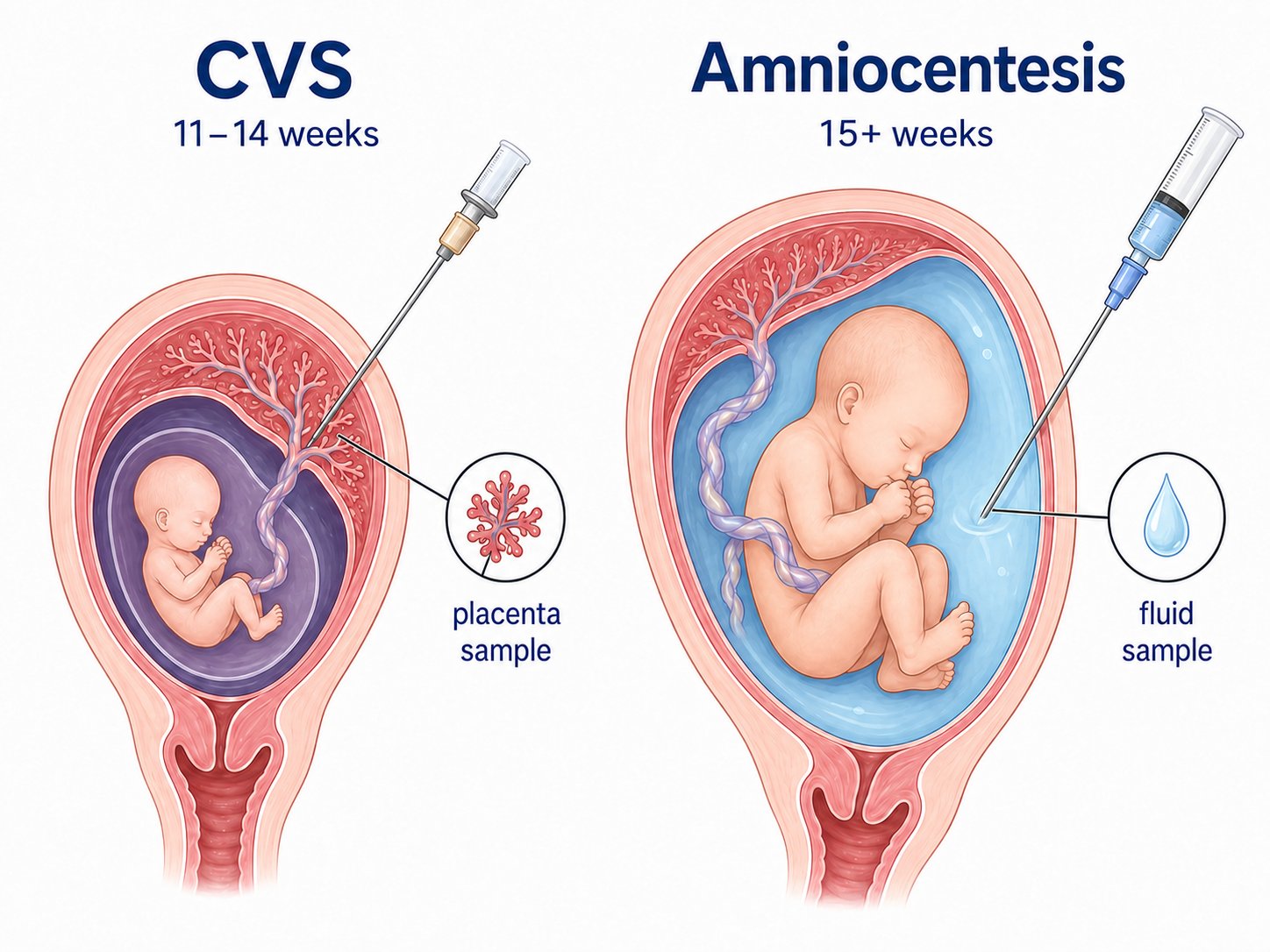
CVS - Chorionic Villus Sampling
Usual timing: 11 weeks 0 days to 13 weeks 6 days.
Sometimes: It may be done from 14 weeks 0 days to 14 weeks 6 days if needed.
Do not do before: 10 weeks 0 days.
Sample: A small piece of the placenta.
How: Usually a thin needle goes through the belly. Sometimes a thin tube goes through the cervix.
- Can be done earlier in pregnancy.
- Results may come earlier.
- Can test chromosomes and many known gene conditions.
- Can give families more time to learn and plan.
- The sample comes from the placenta, not the fluid around the baby.
- Rarely, the placenta may have a chromosome change that the baby does not have. This is called confined placental mosaicism.
- If the result is unclear, an amniocentesis may still be needed.
- CVS does not test the amniotic fluid for AFP.
Amniocentesis ("Amnio")
Usual timing: From 15 weeks 0 days and later.
Often done: Between 15 and 20 weeks, but it can also be done later.
Sample: A small amount of the fluid around the baby.
How: A thin needle goes through the belly into the fluid while ultrasound guides the needle.
- Tests cells found in the fluid around the baby.
- Can test chromosomes and many known gene conditions.
- Can also test the fluid for AFP when a brain or spine opening is a concern.
- Less likely than CVS to be confusing because of a placenta-only result.
- It is done later than CVS.
- You may wait longer to get the answer.
- No test checks for every condition.
When might one test be used?
Medical references used for this handout
- Navaratnam K, Alfirevic Z; Royal College of Obstetricians and Gynaecologists. Amniocentesis and chorionic villus sampling: Green-top Guideline No. 8. BJOG 2022;129:e1-e15.
- RCOG Green-top Guideline No. 8, October 2021. CVS is usually performed between 11+0 and 13+6 weeks; if needed, 14+0 to 14+6 weeks. Amniocentesis is usually offered from 15+0 weeks.
- American College of Obstetricians and Gynecologists. Prenatal Genetic Diagnostic Tests. Patient FAQ.