
Prenatal Diagnostic Genetic Testing at a Glance
Specimen selection, assay choice, common indications, and important blind spots
Clinical principle: specimen acquisition and laboratory testing are separate decisions. CVS and amniocentesis provide fetal/placental material; the laboratory assay should be chosen to answer the specific clinical question. The broadest assay is not always the most appropriate assay.
1. Specimen acquisition
CVS
Placental chorionic villi. Appropriate for many chromosome and molecular tests. Remember the possibility of a placental-only result when interpreting discordant or mosaic findings.
Placental chorionic villi. Appropriate for many chromosome and molecular tests. Remember the possibility of a placental-only result when interpreting discordant or mosaic findings.
Amniocentesis
Amniotic fluid containing fetal cells. Can support chromosome and molecular testing and may be used when a placental result requires clarification.
Amniotic fluid containing fetal cells. Can support chromosome and molecular testing and may be used when a placental result requires clarification.
2. Match the assay to the question
| Test | Best at detecting | Important limitations / may miss | Typical use |
|---|---|---|---|
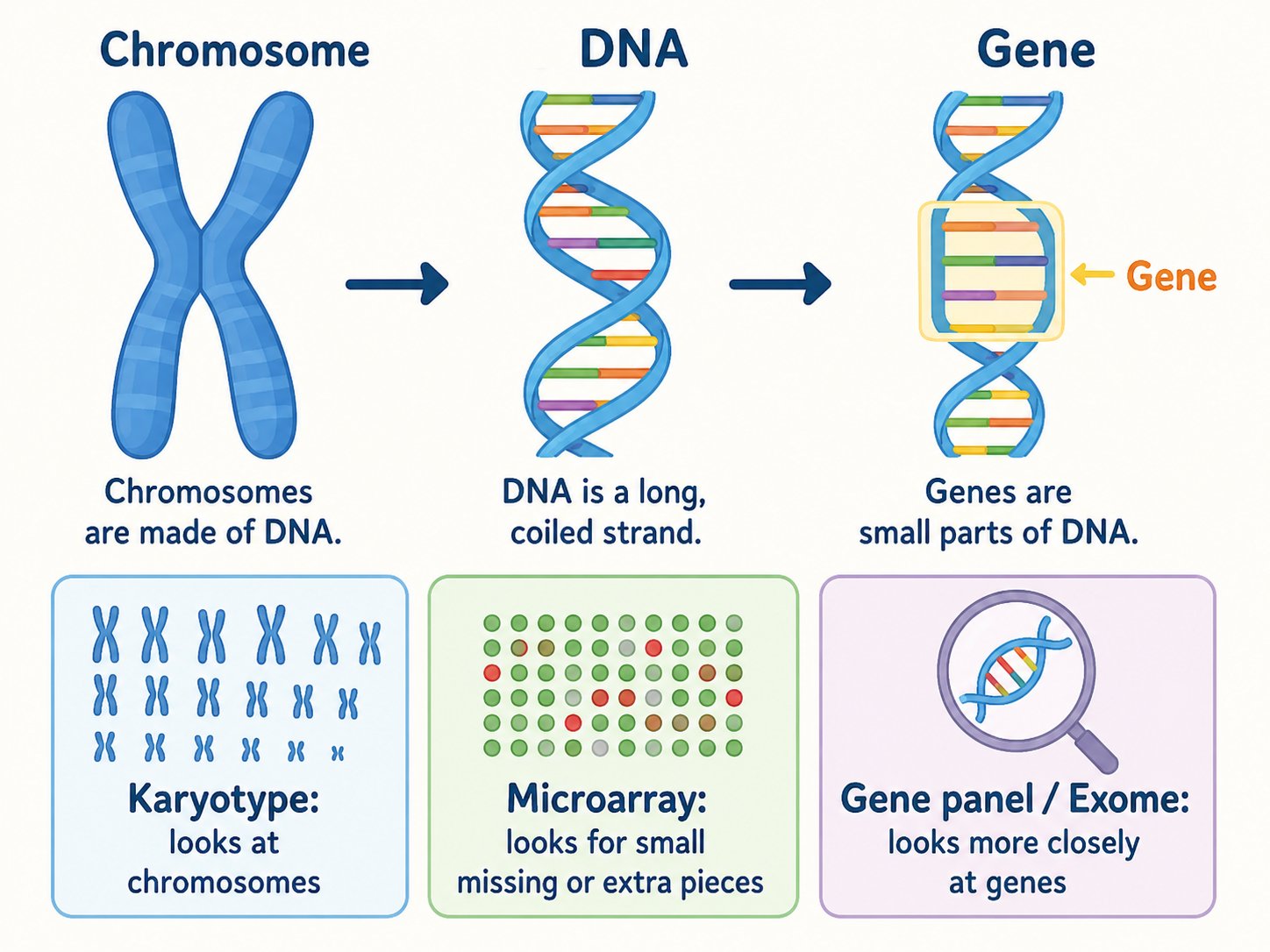
| Karyotype | Aneuploidy and large chromosome rearrangements. | Small copy-number changes and most single-gene disorders. | Whole-chromosome abnormalities; useful when structural rearrangement information is important. |
| Chromosomal microarray (CMA) | Aneuploidy plus smaller deletions/duplications not visible on routine karyotype. | Many single-gene disorders, repeat-expansion disorders such as Fragile X, and some balanced rearrangements. | Often the preferred diagnostic chromosome-level assay when a fetal structural anomaly is present. |
| Targeted single-gene test | A known familial pathogenic variant or a highly specific suspected disorder. | Other genes and disorders outside the targeted locus. | Known familial variant; highly specific phenotype; carrier-couple fetal testing. |
| Gene panel | Pathogenic variants across a phenotype-specific group of genes. | Genes not included on the panel; some variant types depending on assay design. | Phenotype suggests a defined disease group, e.g. skeletal dysplasia or cardiomyopathy panel. |
| Exome sequencing | Sequence variants across many protein-coding genes. | Some copy-number/structural changes, repeat expansions, methylation disorders, and variants outside captured regions. | Selected fetuses with one or more anomalies when chromosome-level testing is nondiagnostic. |
| Specialized assay | Variant classes not reliably assessed by routine CMA/exome. | Usually answers a narrow question rather than providing broad screening. | Repeat-expansion, methylation/imprinting, enzyme, or other disorder-specific testing. |
3. Common targeted scenarios
Spinal muscular atrophy (SMA)
Start with parental carrier information when available. If both parents are carriers or a familial change is known, use an SMN1-specific fetal assay rather than relying on routine CMA or exome alone.
Start with parental carrier information when available. If both parents are carriers or a familial change is known, use an SMN1-specific fetal assay rather than relying on routine CMA or exome alone.
Cystic fibrosis
If both parents carry pathogenic CFTR variants, prenatal diagnosis should target the familial variants.
If both parents carry pathogenic CFTR variants, prenatal diagnosis should target the familial variants.
Fragile X syndrome
Requires an FMR1 CGG-repeat assay; methylation analysis may also be required. Routine CMA or exome does not answer the Fragile X question reliably.
Requires an FMR1 CGG-repeat assay; methylation analysis may also be required. Routine CMA or exome does not answer the Fragile X question reliably.
Fetal structural anomaly
CMA is often a high-yield first diagnostic chromosome-level test because it detects submicroscopic copy-number changes.
CMA is often a high-yield first diagnostic chromosome-level test because it detects submicroscopic copy-number changes.
Multiple anomalies + nondiagnostic CMA
Consider a phenotype-directed gene panel or exome sequencing in an appropriate genetics/MFM framework.
Consider a phenotype-directed gene panel or exome sequencing in an appropriate genetics/MFM framework.
Known familial mutation
Targeted testing is often more direct, faster to interpret, and better aligned with the clinical question than ordering the broadest available assay.
Targeted testing is often more direct, faster to interpret, and better aligned with the clinical question than ordering the broadest available assay.
4. Interpretation pitfalls and special testing
Key limitations
- A normal result does not exclude all genetic disease.
- Variants of uncertain significance may require parental studies or later reinterpretation.
- Assay performance depends on the laboratory platform and variant class.
- CVS can reflect placental genetics; discordant or mosaic results may require additional evaluation.
Specialized testing examples
- Methylation / imprinting: use a disorder-specific methylation assay when clinically indicated.
- Lysosomal storage disorders: targeted molecular testing and, in selected disorders, enzyme testing may be required.
- Repeat expansions: require repeat-specific assays rather than routine CMA/exome.
- Laboratory consultation: confirm that the ordered assay detects the suspected variant class.
Selected references: SMFM Consult Series #41, The use of chromosomal microarray for prenatal diagnosis (reaffirmed 2024); International Society for Prenatal Diagnosis updated position statement on genome-wide sequencing for prenatal diagnosis (endorsed by SMFM); GeneReviews: Spinal Muscular Atrophy, Cystic Fibrosis, and FMR1 Disorders. Use laboratory-specific test specifications and current genetics guidance when ordering and interpreting assays.