Isolated Choroid Plexus Cyst (CPC)
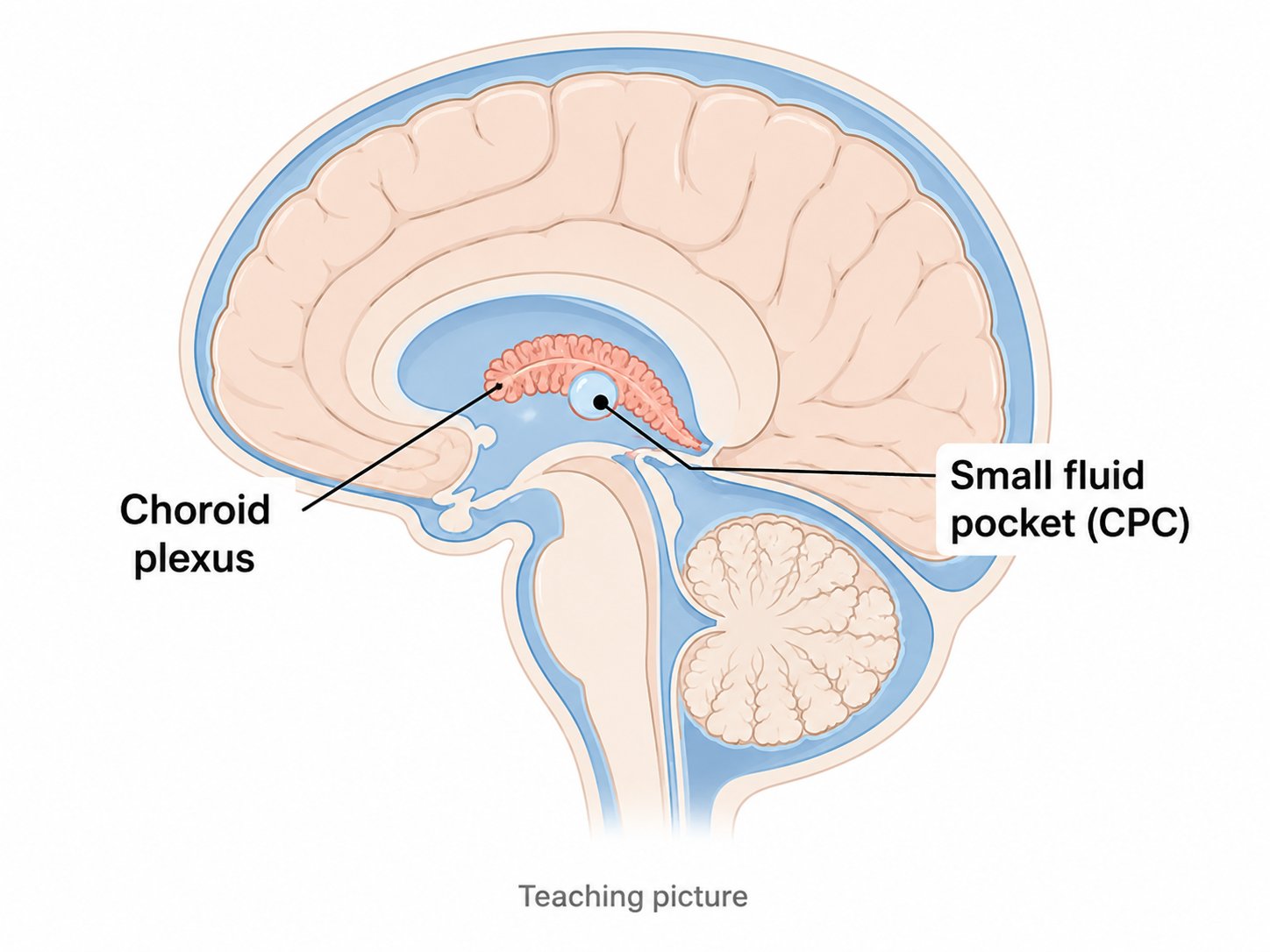
The choroid plexus is a part of the brain that makes fluid.
Sometimes a small pocket of fluid forms there. This is called a choroid plexus cyst, or CPC.
A CPC is not a brain defect. It does not damage the brain and usually goes away on its own.
CPCs are seen in about 1 to 2 out of every 100 babies during the middle of pregnancy.
What does "isolated" mean?
Isolated means a detailed ultrasound exm found the CPC but did not find:
- a major birth defect,
- a problem with the baby's growth, or
- another ultrasound soft marker.
Does a CPC hurt the brain?
- No. It is not a brain abnormality.
- It does not change how the brain works.
- It does not need treatment.
- Nearly all CPCs go away by about 28 weeks.
Why is chromosome screening reviewed?
CPCs can be seen in some babies with trisomy 18. Trisomy 18 means the baby has an extra copy of chromosome 18.
When trisomy 18 is present, the ultrasound almost always shows other problems too.
If your screening was low risk
- No more chromosome testing is recommended just because of an isolated CPC.
- You do not need another ultrasound just to see if the CPC goes away.
- Your baby does not need a special test after birth just because of the CPC.
If you have not had chromosome screening
Your care team should talk with you about the chance of trisomy 18 and your screening choices.
- Cell-free DNA (cfDNA, NIPT) is a blood test that can screen for trisomy 18.
- A quad screen may be used if cfDNA is not available or costs too much.
- Amniocentesis can give a definite chromosome result, but SMFM does not recommend it only because an isolated CPC was found after a low-risk screening result.
Educational use only. This handout does not replace care from your pregnancy doctor. Your care plan may be different. Updated July 2026.
References
- Prabhu M, Kuller JA, Biggio JR. Society for Maternal-Fetal Medicine Consult Series #57: Evaluation and management of isolated soft ultrasound markers for aneuploidy in the second trimester. Am J Obstet Gynecol. 2021;225:B2-B15.
- Peleg D, Yankowitz J. Choroid plexus cysts and aneuploidy. J Med Genet. 1998;35:554-557.