Cleft Lip and Palate
A gap in the baby's upper lip or roof of the mouth
Early in pregnancy, parts of the baby's face grow together. A cleft happens when they do not join all the way.
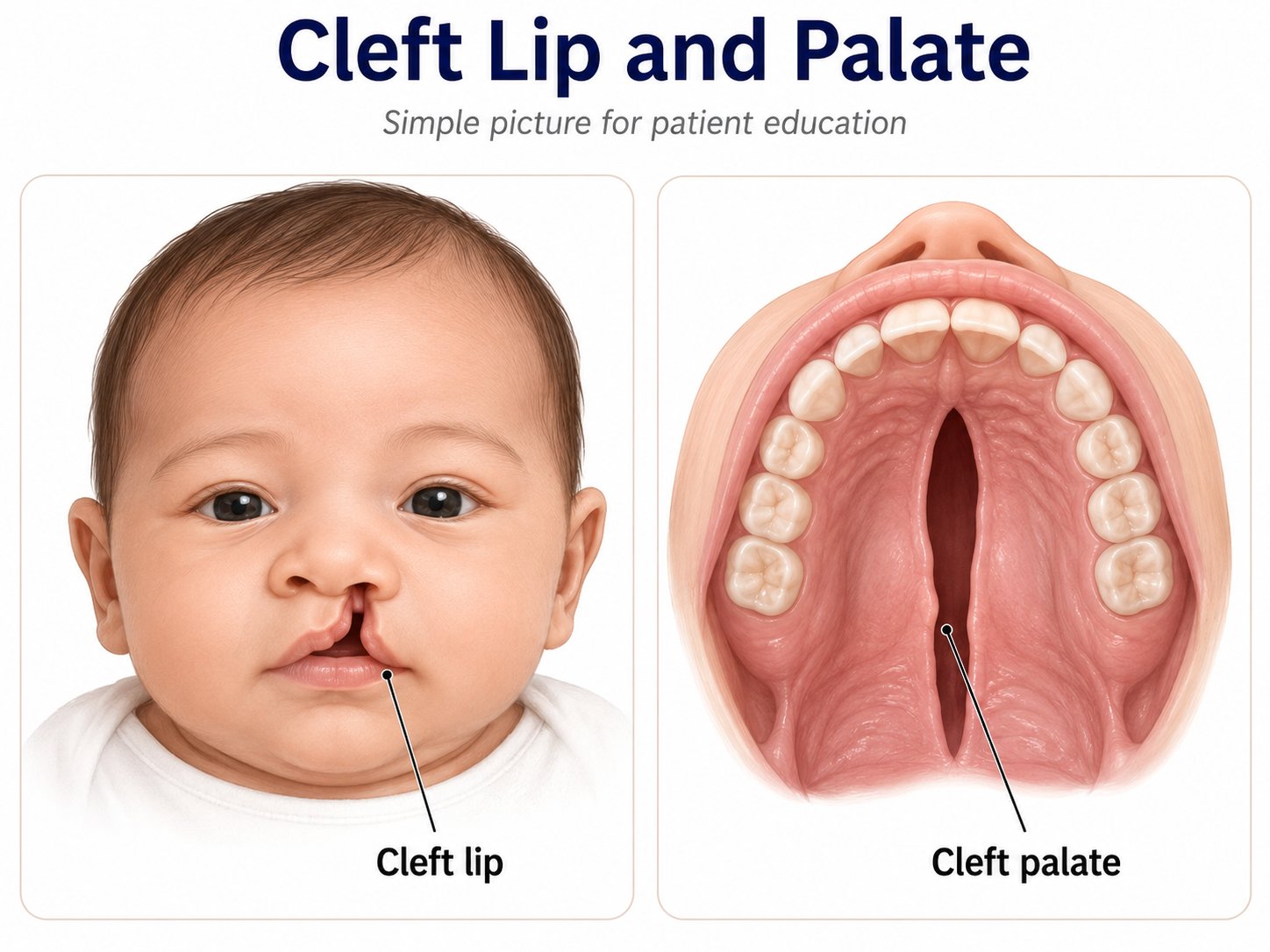
Cleft lip is a gap in the upper lip. It may be on one side or both sides.
Cleft palate is a gap in the roof of the mouth. A baby may have a cleft lip, cleft palate, or both.
Why did this happen?
- a cleft forms very early in pregnancy
- most of the time, there is no single known cause
- genes and other health or pregnancy factors may play a part
- in most cases, nothing a parent did caused the cleft
What happens next?
- a detailed ultrasound checks the face and the rest of the baby
- the palate can be hard to see before birth
- you may meet a genetic counselor and a cleft or craniofacial team
- other scans may be offered if another concern is seen
What genetic tests may be offered?
- NIPT or cell-free DNA can screen for some chromosome conditions
- CVS or amniocentesis can give a more certain answer about chromosomes
- a chromosome microarray may be offered when a cleft is seen
- more gene testing may be discussed if other problems or family history suggest it
What does this mean for my baby?
If the cleft is the only finding and genetic testing is normal, the outlook is usually very good.
A cleft palate can make feeding harder. Some babies need a special bottle.
Hearing, speech, and teeth may need extra care as the child grows.
When is the cleft repaired?
Cleft lipUsually during the first 6 months.
Cleft palateOften around 9 to 14 months.
The cleft team chooses the safest time for your baby. Some children need more treatment later for the nose, palate, teeth, or jaw.
Words you may hear
- isolated cleft: no other birth difference is found
- craniofacial: related to the face and skull
- screening test: estimates the chance of a condition
- diagnostic test: gives a more certain answer
- repair: surgery to close the cleft
Important: Ultrasound can often find a cleft lip before birth. A cleft palate, especially a small cleft in the softer back part of the roof of the mouth, may not be known for sure until the baby is examined after birth.
Medical references and guidance
- Society for Maternal-Fetal Medicine. Fetal Anomalies Consult Series #1: Facial Anomalies. 2019; reaffirmed 2025.
- American College of Obstetricians and Gynecologists. Screening for Fetal Chromosomal Abnormalities. Practice Advisory. January 2026.
- ACOG and SMFM. Microarrays and Next-Generation Sequencing Technology: The Use of Advanced Genetic Diagnostic Tools in Obstetrics and Gynecology.
- Centers for Disease Control and Prevention. Cleft Lip/Cleft Palate. Updated January 8, 2026.
- American Cleft Palate Craniofacial Association. Parameters of Care. Revised 2024.