Down Syndrome
Also called trisomy 21
Down syndrome happens when a baby has an extra chromosome 21.
Chromosomes are small packs inside cells. They carry genes. Genes are instructions that tell the body how to grow and develop.
The extra chromosome can change how the body grows. It can also change how the brain grows.
Most of the time, this happens by chance. A parent did not cause it.
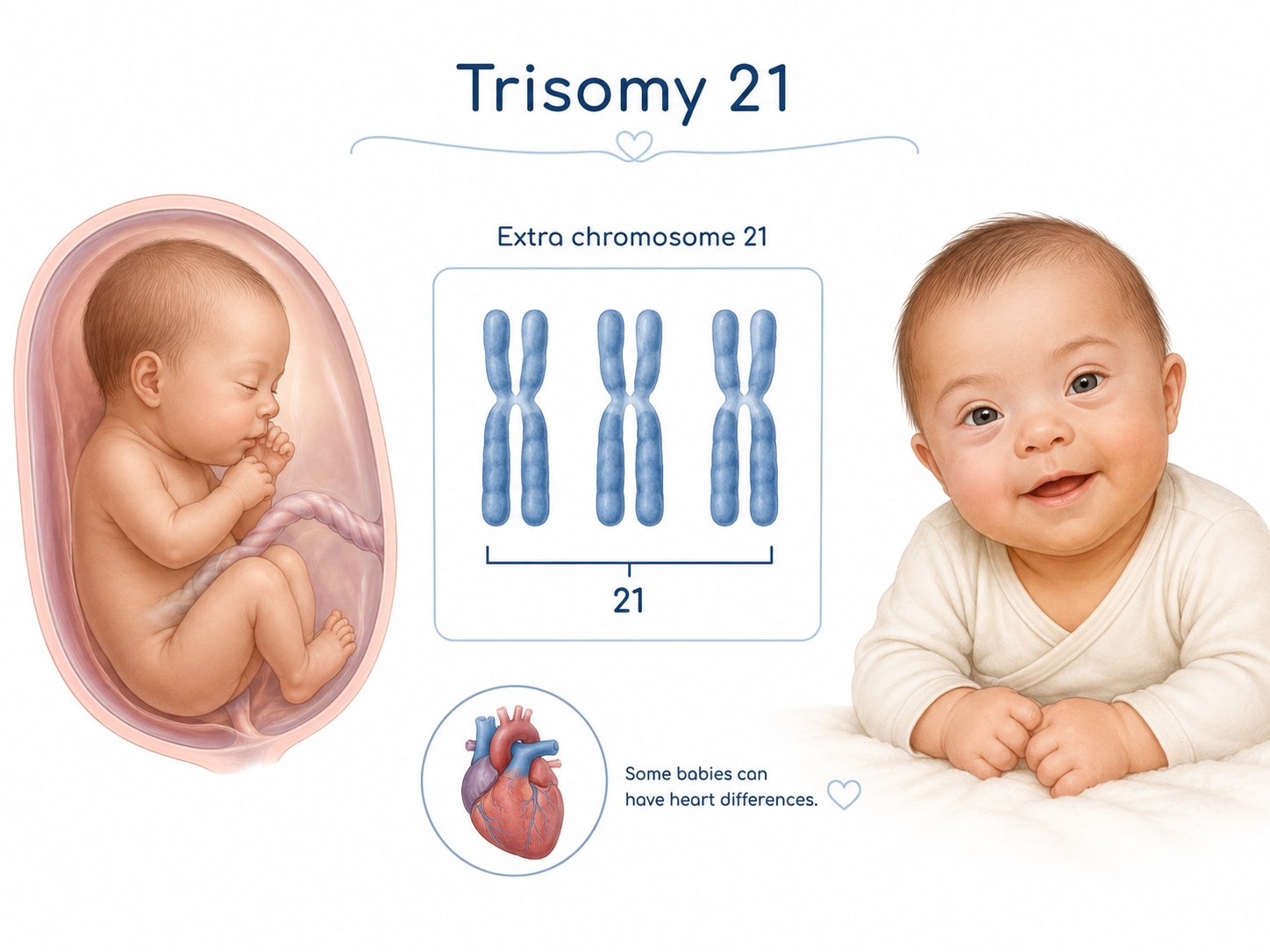
Each child is different. Your care team can help you understand what this may mean for your baby and your family.
How is it found?
- Screening tests tell the chance of Down syndrome. They do not give a sure answer.
- NIPT is a blood test. It is also called cell-free DNA.
- CVS uses a small piece of the placenta.
- Amniocentesis uses a small amount of fluid around the baby.
- CVS or amniocentesis can give a more certain answer.
What happens in pregnancy?
- A genetic counselor can explain genes, tests, and results.
- A detailed ultrasound is a close scan of the baby.
- A fetal echocardiogram is a heart ultrasound.
- More scans may be done later to check growth.
What happens after birth?
- A blood test can confirm Down syndrome.
- The baby should have an echocardiogram, or heart ultrasound.
- Hearing, eyes, feeding, and thyroid are checked.
- Some babies need heart surgery. Some need help with feeding.
What is the outlook?
Many children learn more slowly. Speech may come later too.
Early intervention means early help. It can help with movement, speech, and learning.
Many people with Down syndrome can live active lives. Good care and support can help.
What health problems can happen later?
- Heart problems: some need surgery.
- Hearing and eye problems: regular checks can help.
- Thyroid problems: the thyroid helps with energy and growth.
- Sleep apnea: breathing may stop for short times during sleep.
- Stomach or bowel problems: some children have trouble with bowel movements or gluten foods.
- Low muscle tone: sitting and walking may come later.
- Infections: some children get sick more often.
- Blood problems: leukemia can happen, but it is still not common.
- Seizures: these can happen.
- Neck and spine problems: some children have loose joints in the neck.
- Learning or behavior: extra help at school may be useful.
- As adults: some people have memory loss at a younger age, including Alzheimer disease.
Support & resources for families
Club 21 Learning & Resource Center
Los Angeles-area support, education, programs, and information for new and expecting parents.
National Down Syndrome Society (NDSS)
National information, family resources, health information, and advocacy.
Down Syndrome Association of Los Angeles
Local family support, community programs, education, and service information.
San Gabriel/Pomona Regional Center
Local help with early intervention and developmental services for eligible children and families.
Important: Not every child will have these health problems. Regular checkups can find problems early.
Medical references and guidance
- Centers for Disease Control and Prevention. Down Syndrome. Updated January 8, 2026.
- American Academy of Pediatrics. Health Supervision for Children and Adolescents With Down Syndrome. Pediatrics. 2022.
- NICHD. Down Syndrome: Associated Conditions and Disorders.
- American College of Obstetricians and Gynecologists. Screening for Fetal Chromosomal Abnormalities. Practice Advisory. January 2026.