Isolated Enlarged Cisterna Magna
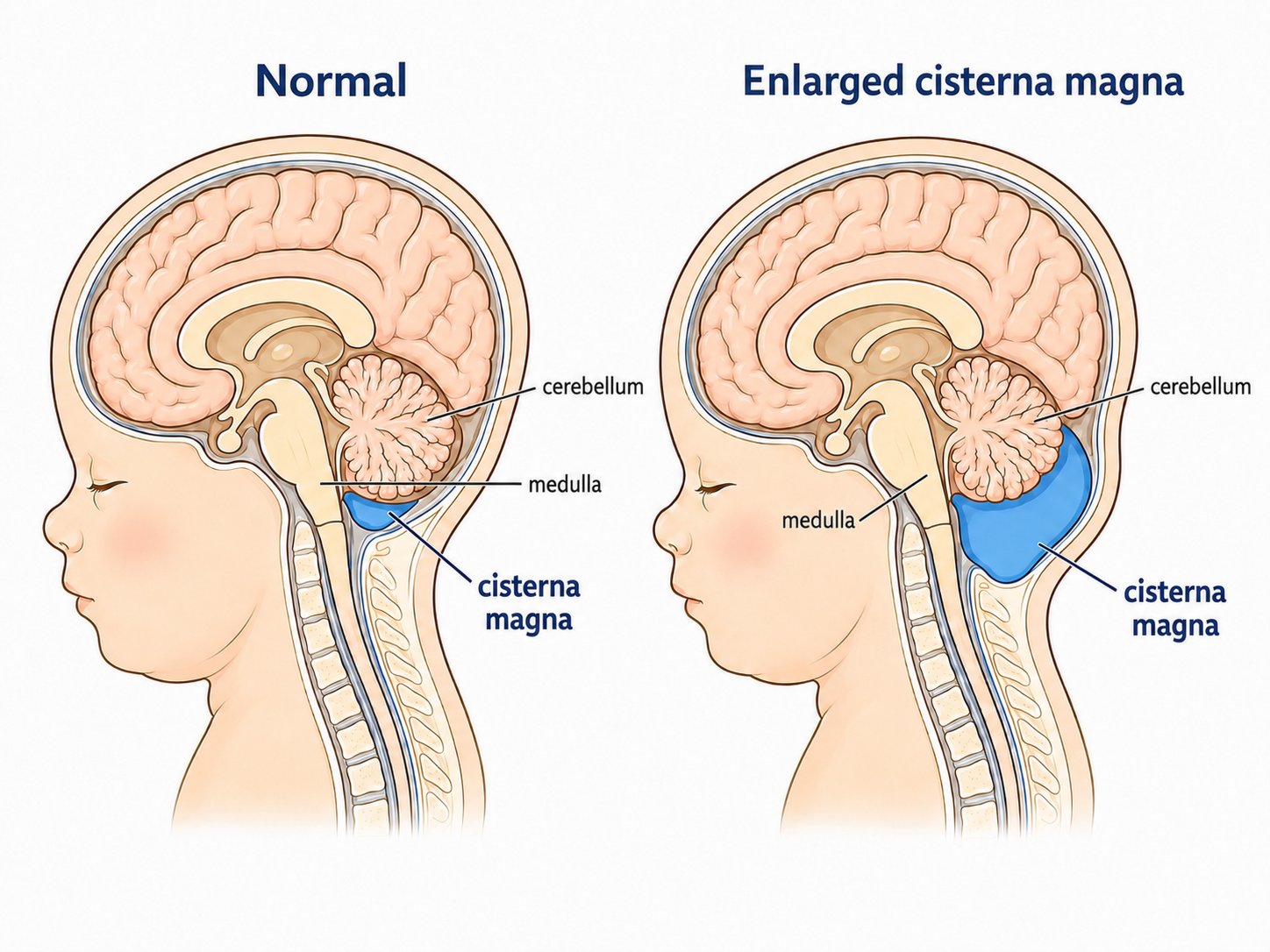
The cisterna magna is a normal pocket of fluid at the back of the baby's brain.
It is below the cerebellum and behind the medulla. The cerebellum is the part of the brain that helps with balance. The medulla is the lower brainstem.
Enlarged means this pocket of fluid looks bigger than usual.
Isolated means the rest of the baby's brain and body look normal on the scan.
What tests may be offered?
- a careful ultrasound
- a detailed brain ultrasound
- a repeat ultrasound later
- fetal MRI, which is a more detailed picture, in some cases
Do I need gene testing?
Gene or chromosome testing may be considered if other abnormalities are present or if there are other risk factors for genetic conditions.
Your doctor may still talk with you about testing or if you want more information.
What does this mean for my baby?
Most babies with this isolated finding have a good outcome.
Many children have normal growth and normal development.
In some pregnancies, the fluid space looks smaller later on.
What happens after birth?
- your baby will have a regular newborn exam
- sometimes a brain ultrasound or other imaging is suggested
- if no other problem is found, treatment is usually not needed
Medical references used for this handout
- NCBI Bookshelf. Mega Cisterna Magna. Updated 2023.
- Kim O, et al. Prenatal Diagnosis and Clinical Outcomes of Isolated Mega Cisterna Magna. Journal of Child Neurology. 2024.
- ISUOG Patient Information Series. Mega Cisterna Magna (MCM) and Arachnoid Cysts (AC). Updated 2023.