Placenta Accreta Spectrum
When the placenta is stuck too deep in the wall of the womb
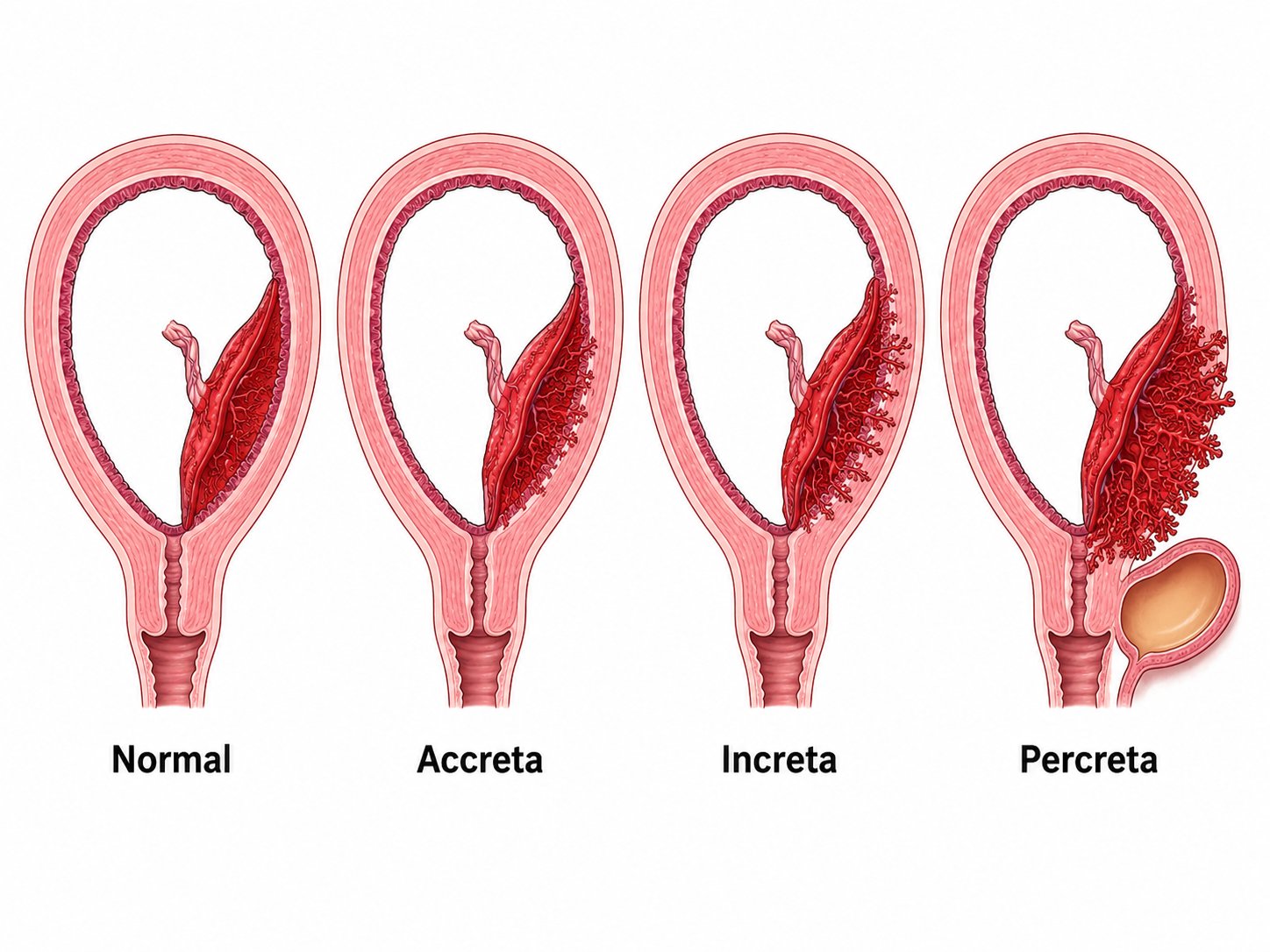
Placenta accreta spectrum (PAS) means the placenta is stuck too deep in the wall of the womb. The placenta gives the baby oxygen and food.
After birth, the placenta should come away from the womb. With PAS, it may stay stuck. This can cause very heavy bleeding.
Why can this happen?
- The risk is higher after a past cesarean section.
- The risk goes after each additional cesarean section.
- Placenta previa also raises risk. This means the placenta is over or near the cervix.
- Other surgery on the womb can also raise risk.
How is PAS found?
- Ultrasound is the main test.
- Your doctor checks the placenta, womb wall, and blood flow.
- An MRI may help if the ultrasound is not clear. It is not the first test for most people.
- A normal-looking scan may not rule out PAS when risk is high.
What happens in pregnancy?
- You may have more ultrasounds.
- A team that knows PAS well should care for you.
- Your doctor may check for anemia (low red blood cells) and low iron.
- Bed rest or pelvic rest has not been shown to help everyone. Your doctor will make a plan for you.
When is birth planned?
If you are doing well, birth is often planned from 34 weeks through 35 weeks and 6 days.
Birth may need to happen sooner if you bleed, go into labor, or your water breaks.
Steroid shots may help the baby's lungs if birth will be before 37 weeks.
What happens at birth?
Birth is usually by C-section at a hospital with a PAS team.
In many cases, doctors leave the placenta in place and remove the womb. This is called a hysterectomy.
After a hysterectomy, you cannot carry another pregnancy.
Why leave the placenta in place?
Trying to pull the placenta off can cause very heavy bleeding.
You may need a blood transfusion. This means you get donated blood.
Severe PAS can affect the bladder or other organs. More surgeons may be needed.
Medical references and guidance
- American College of Obstetricians and Gynecologists (ACOG) and Society for Maternal-Fetal Medicine (SMFM). Obstetric Care Consensus No. 7: Placenta Accreta Spectrum.
- SMFM Special Report: ultrasound markers and approach to pregnancies at risk for placenta accreta spectrum; reaffirmed March 2025.