Placenta Previa
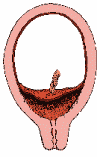
When the placenta covers the opening of the womb
The placenta, also called the afterbirth, is the organ that develops during pregnancy between the mother and the baby. It gives your baby oxygen and food.
The cervix is the opening at the bottom of the womb.
Placenta previa means the placenta covers the cervix.
If it still covers the cervix near birth, the baby cannot safely come through the vagina.
Why does it matter?
- placenta previa can cause bleeding
- the bleeding may not hurt and can be heavy
- heavy bleeding can be dangerous for you and your baby
What happens next?
- you will usually have another ultrasound at about 32 weeks
- an ultrasound through the vagina is safe and gives the best view
- if the placenta still covers the cervix, another scan may be done near 36 weeks
How will my baby be born?
- if the placenta still covers the cervix, the baby will need to be delivered by cesarean section (C-section)
- if you and your baby are stable, birth is usually planned between 36 weeks and 37 weeks 6 days
- your baby may need to be born sooner if you have heavy bleeding or labor
What should I do?
- keep all prenatal and ultrasound visits
- ask your care team about sex, hard exercise, and travel
- follow your care team's instructions if you have bleeding
Important before an exam
An ultrasound through the vagina is safe.
An exam using the fingers can cause heavy bleeding and should not be done unless your care team says it is safe.
Call your hospital now if you have:
- any bleeding from the vagina
- contractions, belly pain, or leaking fluid
- dizziness, weakness, fainting, or trouble breathing
- your baby is moving less than usual
Do not stay home if you are bleeding.
Even a small amount of bleeding should be checked. Call 911 for heavy bleeding, fainting, or trouble breathing.
Educational use only. This handout does not replace care from your pregnancy doctor. Your care plan may be different.
Medical references used for this handout
- Society for Maternal-Fetal Medicine. Consult Series #44: Management of bleeding in the late preterm period. Reaffirmed 2024.
- Royal College of Obstetricians and Gynaecologists. Placenta praevia, placenta accreta and vasa praevia. Patient information.
- Reddy UM, et al. Fetal imaging: executive summary of a joint NICHD/SMFM/AIUM/ACOG/ACR/SPR/SRU workshop. J Ultrasound Med. 2014;33:745-757.