Succenturiate or Bilobed Placenta
When the placenta grows in more than one piece
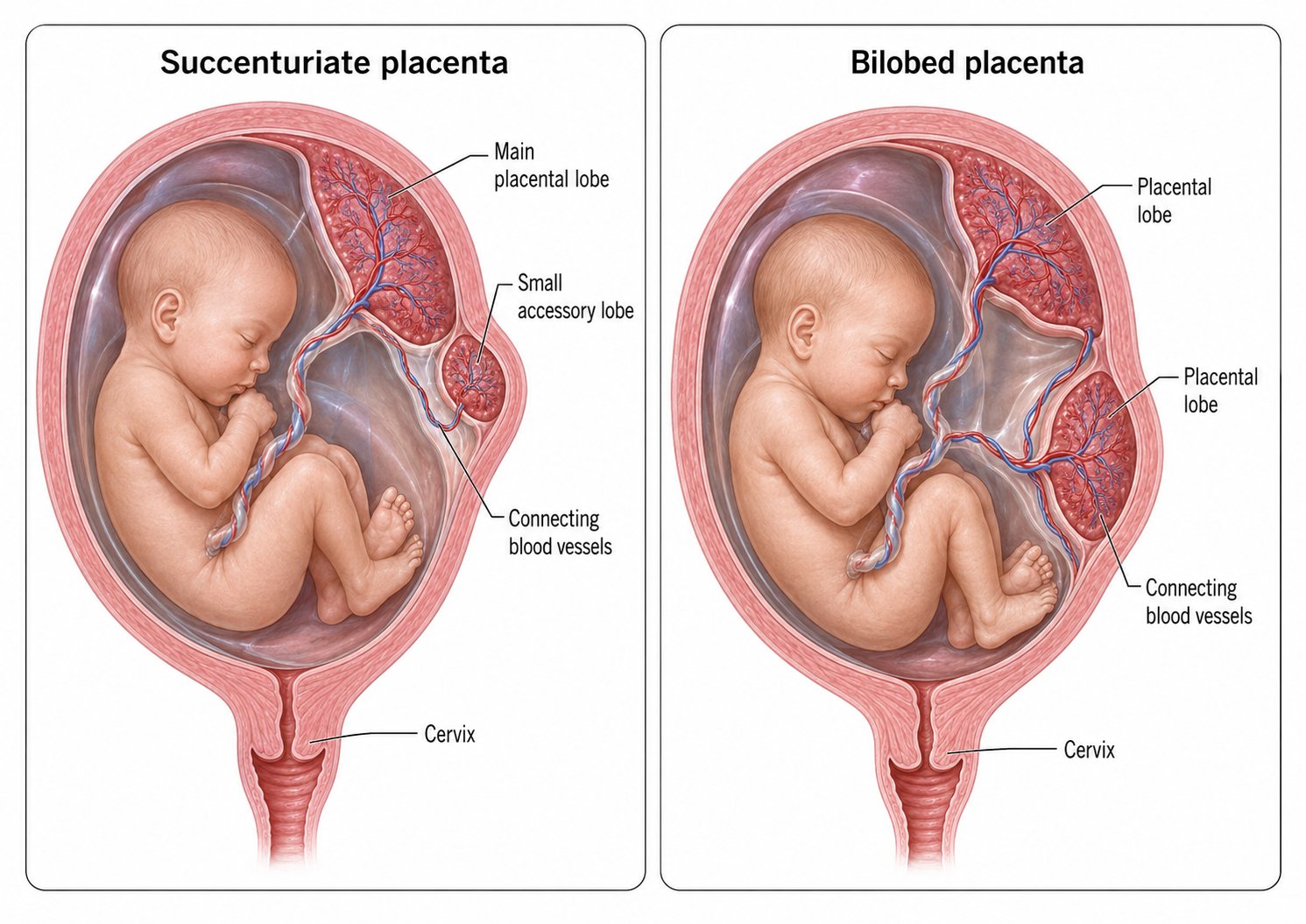
The placenta gives your baby oxygen and food. Sometimes the placenta grows in more than one piece.
- A succenturiate placenta has one main piece and one smaller extra piece.
- A bilobed placenta has two pieces that are about the same size.
Blood vessels may join the pieces.
Why did this happen?
Doctors often do not know why this happens.
It starts while the placenta is growing early in pregnancy. Parts of the placenta may keep growing in separate places.
It is seen more often after in vitro fertilization (IVF). It may also happen near a fibroid or an old scar in the uterus. It can happen without any of these.
Nothing you did is known to cause it.
What does this mean?
Most of the time, the pregnancy goes well.
Your care team will check where the cord joins the placenta. They will also check where blood vessels run.
The goal is to make sure no baby blood vessels pass over or very close to the cervix.
What problems can happen?
- Some blood vessels may run through the thin bag around the baby.
- If these vessels pass over or very close to the cervix, it is called vasa previa..
- After birth, a small piece of placenta can sometimes stay in the uterus. This can cause heavy bleeding.
What follow-up is needed?
- A detailed ultrasound will look at both pieces.
- An ultrasound using Color Doppler may be used to show blood flow.
- Your doctor will check for vessels near the cervix.
- More ultrasound may be done if needed.
What about delivery?
If no vessels are near the cervix and there are no other problems, vaginal birth is often possible.
If vasa previa is found, your doctor will make a special birth plan. This often includes a C-section before labor starts.
After birth, the placenta is checked to make sure all pieces came out.
Call your doctor right away for
- Vaginal bleeding
- Fluid leaking from the vagina
- Strong or regular contractions
- Less baby movement later in pregnancy
Educational use only. This handout gives general information. It does not replace care from your pregnancy doctor.
References
- Society for Maternal-Fetal Medicine. Consult Series #37: Diagnosis and management of vasa previa. Reaffirmed 2024.
- StatPearls. Placenta Abnormalities: bilobed and succenturiate placenta.
- Society for Maternal-Fetal Medicine. Consult Series #60: Management of pregnancies resulting from in vitro fertilization. Reaffirmed 2024.