Normal CNS anatomy & standard planes

Evaluation of the fetal central nervous system relies on standardized axial, coronal, and sagittal planes. A Level II exam typically includes assessment of ventricles, midline structures, cerebellum, vermis, cisterna magna, and spine.

Axial planes

  • Transventricular plane:
    • Lateral ventricles, atria, and choroid plexus.
    • Atrial width measured at the level of the glomus of choroid plexus.
  • Transthalamic plane:
    • Cavum septi pellucidi (CSP), thalami, and midline falx.
    • Used for head circumference and biparietal diameter.
  • Transcerebellar / posterior fossa plane:
    • Cerebellum (transcerebellar diameter), cisterna magna, and nuchal region.

Sagittal and coronal views

  • Mid-sagittal view:
    • Corpus callosum, cavum septi pellucidi, brainstem, vermis, and fourth ventricle.
  • Parasagittal and coronal views:
    • Hemisphere symmetry, sulcation pattern, and cortical development.
Standard fetal brain axial planes (schematic)
Standard axial planes for fetal brain: transventricular, transthalamic, and transcerebellar views (schematic placeholder).

The absence of key structures (e.g., CSP, midline falx) or distortion of expected anatomy prompts more detailed neurosonography and consideration of MRI in selected cases.

Ventriculomegaly

Ventriculomegaly refers to enlargement of the lateral cerebral ventricles, most commonly assessed at the level of the atria in the transventricular plane.

Measurement & thresholds

  • Atrial width measured from inner edge to inner edge at the level of the glomus of the choroid plexus.
  • Values are relatively stable across gestation after mid-second trimester.
Category Atrial measurement (approximate)
Normal < 10 mm
Mild ventriculomegaly 10–12 mm
Moderate ventriculomegaly 13–15 mm
Severe ventriculomegaly > 15 mm
Table: Commonly used categories of ventriculomegaly based on lateral ventricular atrial width.

Unilateral vs bilateral and progression

  • Unilateral:
    • May suggest localized obstruction, hemorrhage, or mass; can also be variant.
  • Bilateral:
    • More often associated with chromosomal, genetic, or infectious etiologies.
  • Serial measurements help distinguish stable, improving, or progressive ventriculomegaly.

Etiologic considerations

  • Chromosomal abnormalities and genetic syndromes.
  • Structural CNS malformations (e.g., ACC, posterior fossa anomalies, holoprosencephaly spectrum).
  • Infection (e.g., CMV, toxoplasmosis) and brain injury.
  • Idiopathic / isolated mild ventriculomegaly.
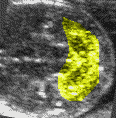
Mild ventriculomegaly ultrasound example
Mild ventriculomegaly: lateral ventricle atrial width in the 10–12 mm range (illustrative placeholder image).

Workup typically includes a detailed anatomic survey, consideration of aneuploidy testing, infection evaluation when indicated, and serial ultrasound to follow evolution of ventricular size and associated findings.

Posterior fossa anomalies

Posterior fossa evaluation focuses on the cerebellar hemispheres, vermis, fourth ventricle, and cisterna magna.

     The posterior fossa is imaged by angling the transducer from the occipitofrontal plane (BPD view) posteriorly. The image should contain the cisterna magna, the cerebellar hemispheres, the brainstem, and the cavum. At about 9-12 weeks the rhombic lips, immediately below the mesencephalon, fuse to form the vermis medially and the globe-like cerebellar hemispheres laterally. The process continues inferiorly forming the roof of the fourth ventricle. Fusion is observed on ultrasound to be complete in all fetuses by 18 weeks. The fourth ventricle anterior to the cerebellum is not routinely visualized unless enlarged.

     Abnormalities may involve vermian development, cystic structures, or size and shape of the posterior fossa.

Dandy–Walker spectrum

  • Dandy–Walker malformation:
    • Cystic dilation of the fourth ventricle.
    • Complete or partial agenesis of the cerebellar vermis.
    • Enlarged posterior fossa with upward displacement of the tentorium.
  • Dandy–Walker variant / vermian hypoplasia:
    • Incomplete vermis with variable communication between fourth ventricle and cisterna magna.

Blake’s pouch cyst & mega cisterna magna

  • Blake’s pouch cyst:
    • Cystic dilatation posterior to an otherwise normally formed vermis.
    • Often associated with a “keyhole” or ballooning appearance of the fourth ventricle.
  • Mega cisterna magna:
    • Enlarged cisterna magna (>10 mm) with normal vermis and cerebellar hemispheres.
    • May be isolated or associated with other anomalies.
Posterior fossa schematic
Posterior fossa schematic showing normal vermis, cerebellum, and cisterna magna (illustrative placeholder).

A mid-sagittal view is particularly important to assess vermian integrity and the relationship of the fourth ventricle and cisterna magna. Selected cases may benefit from MRI for detailed posterior fossa anatomy.

Corpus callosum & midline anomalies

The corpus callosum is the major commissural tract connecting the cerebral hemispheres. Abnormalities include complete agenesis, partial agenesis, and hypoplasia, often accompanied by other brain anomalies.

Agenesis of the corpus callosum (ACC)

  • Indirect signs on axial views:
    • Absent cavum septi pellucidi (CSP) beyond the expected gestational age.
    • High-riding third ventricle and widened interhemispheric fissure.
    • “Colpocephaly” (disproportionate dilatation of occipital horns).
  • Direct visualization on mid-sagittal view:
    • Absent or abnormally short callosal structure.

Other midline abnormalities

  • Absent or abnormal CSP without ACC, seen in some neuronal migration disorders or destructive lesions.
  • Interhemispheric cysts associated with ACC or other malformations.
ACC schematic
Schematic representation of agenesis of the corpus callosum with colpocephaly (illustrative placeholder).

ACC can be isolated or part of broader syndromes. Detailed neurosonography, MRI, and genetic evaluation may be considered when ACC is suspected.

Holoprosencephaly spectrum

Holoprosencephaly represents a spectrum of failed or incomplete division of the forebrain into two hemispheres. Forms are generally classified as alobar, semilobar, and lobar.

Alobar holoprosencephaly

  • Single, large midline ventricle with absent interhemispheric fissure.
  • Absent CSP and corpus callosum.
  • Fused thalami.

Semilobar & lobar forms

  • Semilobar:
    • Partial separation of posterior cerebrum; continued fusion anteriorly.
    • Abnormal ventricular morphology and midline structures.
  • Lobar:
    • More complete separation of hemispheres with subtle midline anomalies.

Facial anomalies are frequently associated and range from cyclopia, proboscis, and midline facial clefts to more subtle midline deficits. Detailed facial evaluation is recommended and cross-referenced to the facial Level II module.

Holoprosencephaly is associated with chromosomal abnormalities (e.g., trisomy 13) and single-gene disorders. When suspected, comprehensive anatomic survey and genetic counseling are essential.

Neural tube defects & cranial vault anomalies

Neural tube defects (NTDs) and cranial vault anomalies involve failure of closure or development of the neural tube and surrounding structures. Many have characteristic cranial and spinal ultrasound findings.

Open spina bifida (myelomeningocele)

  • Cranial signs:
    • “Lemon sign”: scalloping of frontal bones (more prominent earlier in gestation).
    • “Banana sign”: cerebellum pulled posteriorly and inferiorly, with obliteration of cisterna magna.
    • Ventriculomegaly can develop over time.
  • Spinal findings:
    • Defect in posterior elements of vertebrae.
    • Exposed neural tissue or sac at the site of the defect.

Anencephaly / acrania

  • Anencephaly:
    • Absence of cranial vault and most of the cerebral hemispheres.
    • Exposed brain tissue early (“exencephaly”) evolving to absent cerebral tissue.
  • Acrania:
    • Absence of the calvarium with relatively preserved but abnormal brain tissue early in gestation.

Encephalocele

  • Herniation of intracranial contents through a skull defect.
  • Content may be CSF alone (meningocele) or brain tissue (encephalocele).
  • Most commonly occipital, but can be frontal or parietal.
Spina bifida cranial signs schematic Spina bifida cranial signs schematic
Classic cranial signs of open spina bifida: lemon-shaped skull and banana-shaped cerebellum

NTDs may be isolated or part of broader syndromes and chromosomal abnormalities. Evaluation includes a full anatomic survey, assessment of ventricles and posterior fossa, and counseling regarding associated anomalies.

Brain injury & destructive lesions

Acquired brain lesions may result from hemorrhage, infarction, infection, or hypoxic–ischemic injury. They often lead to parenchymal volume loss, cystic changes, or altered echogenicity.

Intraventricular & intracerebral hemorrhage

  • Increased echogenicity within ventricles or parenchyma in acute stages.
  • Later evolution to cystic changes, ventricular dilatation, or porencephalic cysts.

Porencephaly & stroke

  • Porencephalic cysts:
    • Cystic cavities in the brain that may communicate with the ventricular system or subarachnoid space.
    • Often represent prior destructive lesions (e.g., infarction, hemorrhage).
  • Arterial ischemic stroke:
    • Unilateral parenchymal echogenicity acutely, with later tissue loss and asymmetry.

Infection & white matter injury

  • TORCH infections (e.g., CMV, toxoplasmosis) may cause periventricular echogenicity, calcifications, and ventriculomegaly.
  • Periventricular leukomalacia (PVL) manifests as increased echogenicity around ventricles and later cystic change.

When destructive lesions are suspected, evaluation for infection, thrombophilia, twin complications, and other systemic causes is often indicated. MRI may assist in characterizing white matter and cortical injury.

Cysts & intracranial masses

Intracranial cysts and masses range from benign developmental variants to rare neoplasms. The location, internal characteristics, and associated findings guide the differential diagnosis.

Arachnoid cyst

  • Extra-axial, anechoic lesion with well-defined borders.
  • May cause mass effect and displacement of adjacent structures.
  • No internal vascularity on Doppler.

Choroid plexus cyst

  • Anechoic space within the choroid plexus, typically in the atrium of the lateral ventricle.
  • Often transient and isolated; also seen in the context of aneuploidy (e.g., trisomy 18).

Tumors (brief overview)

  • Rare but may present as solid, cystic, or mixed masses (e.g., teratoma, glioma).
  • Often associated with hydrocephalus and sometimes polyhydramnios.

The distinction between arachnoid cysts, porencephalic cysts, and other cystic lesions relies on location, communication with CSF spaces, and associated parenchymal changes. Follow-up imaging and MRI may be helpful.

Key CNS measurements & reference values (overview)

Several CNS measurements are used in fetal ultrasound to screen for abnormal development. Detailed, GA-specific norms and Z-scores are covered in dedicated biometry calculators; this section summarizes commonly used thresholds.

Lateral ventricular atrial width

  • Measured in the transventricular plane at the level of the glomus of the choroid plexus.
  • Normal upper limit ≈ 10 mm across mid-gestation and beyond.

Cisterna magna

  • Measured from vermis to inner table of occipital bone in the transcerebellar/posterior fossa plane.
  • Typical range ≈ 2–10 mm in the mid-second and third trimester.

Transcerebellar diameter (TCD)

  • Measured in the transcerebellar plane across the outer margins of the cerebellar hemispheres.
  • In mid-gestation, TCD (mm) roughly approximates gestational age (weeks) as a rule of thumb.

Cavum septi pellucidi (CSP)

  • Typically seen between approximately 18 and 37 weeks of gestation.
  • Absent CSP beyond this window, especially with other abnormalities, suggests midline pathology.
Link to detailed biometry tools

For GA-specific reference curves, Z-scores, and percentile calculations, see the fetal biometry calculators:

SEE ALSO
SMFM Fetal Anomalies Consult Series #3: Intracranial Anomalies
ISUOG guidelines on the sonographic examination of the fetal CNS (part 1)

References

Selected classic and frequently cited references related to fetal CNS imaging and anomalies are listed in abbreviated form. Contemporary guidelines and specialized neurosonography texts should also be consulted.

  1. AIUM Practice Parameter for the Performance of Detailed Second- and Third-Trimester Diagnostic Obstetric Ultrasound Examinations./li>
  2. ISUOG guidelines on sonographic examination of the fetal central nervous system.
  3. Pilu G, et al. Fetal neurosonography: systematic approach to CNS imaging in the second and third trimester.
  4. Ghi T, et al. Prenatal diagnosis and outcome of ventriculomegaly and mild ventriculomegaly.
  5. Malinger G, et al. Prenatal diagnosis of agenesis of the corpus callosum and associated anomalies.
  6. Simon EM, et al. Posterior fossa malformations in fetuses and neonates: imaging spectrum and classification.
  7. Nyberg DA, et al. Fetal central nervous system malformations: sonographic detection and correlation with outcome.
Show expanded citation notes

ISUOG CNS guidelines. Provide structured recommendations for basic and detailed CNS views, including axial and sagittal planes, and minimal documentation requirements.

Malinger G, et al. Describe imaging findings, associated anomalies, and prognostic considerations in agenesis of the corpus callosum.

Simon EM, et al. Review the spectrum of posterior fossa abnormalities and emphasize the role of mid-sagittal imaging and MRI correlation.

PMIDs, DOIs, and full citation formatting can be added or harmonized with other Level II modules according to your site's reference style.