Marginal and Velamentous Cord Insertion
The umbilical cord brings oxygen and food from the placenta to your baby.
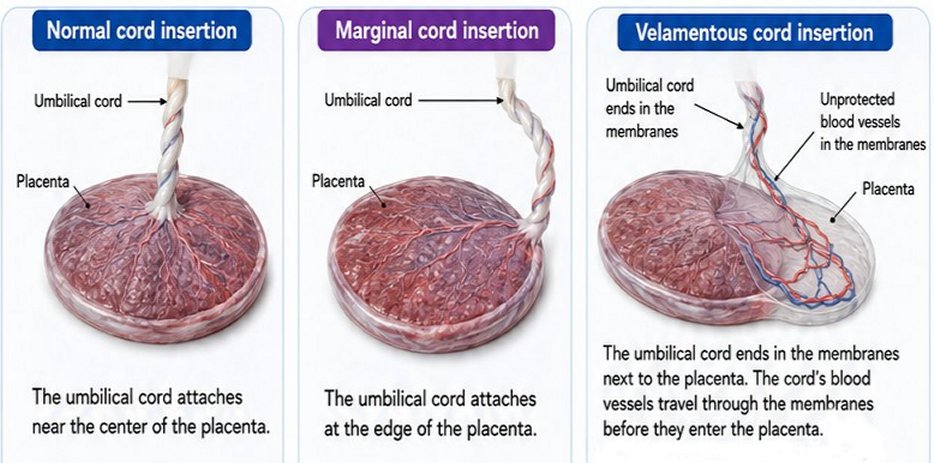
A marginal cord insertion means the cord attaches very close to the edge of the placenta, usually within 2 centimeters of the edge.
A velamentous cord insertion means the cord ends in the thin membranes next to the placenta. The cord's blood vessels then travel through the membranes before they enter the placenta.
Marginal cord insertion
The cord goes into the placenta very close to the edge.
Many babies grow well. Your doctor may order another ultrasound later to check growth.
Velamentous cord insertion
The cord does not go straight into the placenta.
Instead, its blood vessels travel through the membranes before they reach the placenta.
Why is growth checked?
Some babies with either type of cord insertion may be smaller than expected.
Ultrasound can measure your baby and check the fluid around the baby.
Is baby testing needed?
For velamentous cord insertion, weekly baby testing is often recommended starting at 36 weeks.
This may be an NST or a BPP. These tests check your baby's well-being.
What about a marginal insertion?
For a marginal insertion by itself, weekly testing is not always needed. Care depends on your baby's growth and whether there are any other problems.
What should I remember?
The location of the cord attachment can affect how your care team follows your baby's growth and well-being.
Your doctor will make a plan based on the whole pregnancy.
What your care team may do
Medical references used for this handout
- American College of Obstetricians and Gynecologists. Committee Opinion No. 828: Indications for Outpatient Antenatal Fetal Surveillance. Developed with the Society for Maternal-Fetal Medicine. Obstet Gynecol. 2021;137:e177-e197.
- Hasegawa J, et al. Clinical significance of pregnancies with velamentous cord insertion: a systematic review. AJOG MFM. 2023;5(6):100930.