Hypoplastic or Absent Nasal Bone
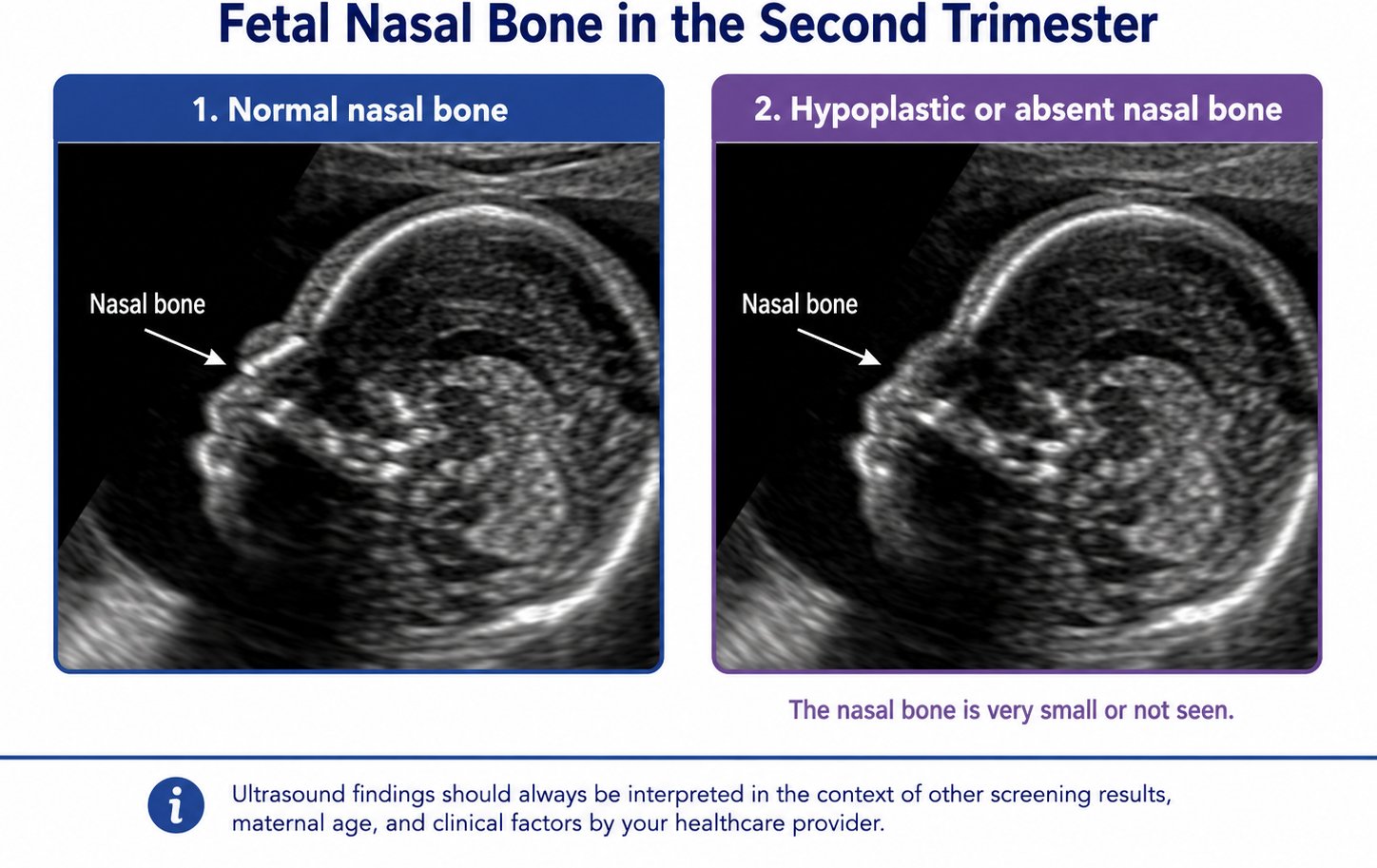
When the baby's nose bone looks very small or is not seen
The nasal bone is a small bone in the baby's nose.
On ultrasound, it may look smaller than usual or may not be seen.
Hypoplastic means smaller than usual. Absent means it is not seen.
Isolated means it is the only finding after a detailed ultrasound.
This finding can raise the chance of Down syndrome, but it does not make a diagnosis by itself.
What happens first?
- a detailed ultrasound checks for other findings
- if no other findings are seen, it is called isolated
- your care team reviews your earlier screening results
If you have not had screening
- SMFM recommends counseling about the chance of trisomy 21, also called Down syndrome
- cell-free DNA screening may be offered
- a quad screen or amniocentesis may also be discussed
If earlier blood screening was low risk
- SMFM recommends counseling about the chance of trisomy 21
- choices may include no more testing, cell-free DNA screening, or amniocentesis
If cell-free DNA was low risk
If cell-free DNA screening was negative and the nasal bone finding is isolated, SMFM recommends no more testing for chromosome problems just because of this finding.
What is a soft marker?
A soft marker is an ultrasound finding that can change the chance of a chromosome condition.
It is not a birth defect and does not prove that the baby has a chromosome problem.
What should I remember?
- this finding can raise risk, but it does not make a diagnosis
- your earlier screening results are very important
- your care team will help you choose the next step
Educational use only. This handout does not replace advice from your obstetrician or maternal-fetal medicine specialist.
Medical references used for this handout
- Society for Maternal-Fetal Medicine. Consult Series #57: Evaluation and management of isolated soft ultrasound markers for aneuploidy in the second trimester. Am J Obstet Gynecol. 2021;225:B2-B15.
- American College of Obstetricians and Gynecologists. Practice Bulletin No. 226: Screening for Fetal Chromosomal Abnormalities. Obstet Gynecol. 2020;136:e48-e69.