Isolated Pyelectasis
A mild widening of the urine-collecting area in a baby's kidney
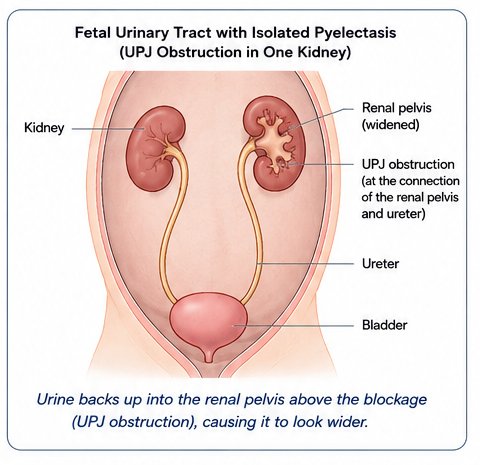
The renal pelvis is the part of the kidney where urine collects before it moves to the bladder.
Pyelectasis means this space looks wider than usual on ultrasound.
Isolated means no other problem was seen on the detailed ultrasound.
This finding does not mean the baby's kidneys have stopped working.
What can cause it?
- often, no clear cause is found
- urine may drain more slowly from the kidney
- there may be a narrowing where the kidney joins the ureter (UPJ obstruction)
- less often, urine may flow backward from the bladder
What happens during pregnancy?
- a repeat ultrasound may be done later
- the kidneys, bladder, and amniotic fluid are checked
- your care team watches to see if the widening gets smaller, stays the same, or gets larger
Does it mean Down syndrome?
Mild pyelectasis can be a soft marker for Down syndrome.
If your cell-free DNA or other chromosome screening was low risk, isolated mild pyelectasis usually does not need more chromosome testing.
What happens after birth?
- your baby may need a kidney ultrasound
- timing depends on how wide the renal pelvis is and whether one or both kidneys are involved
- some babies need to see a kidney or urinary specialist
- only a small number need surgery or other treatment
How the urinary tract works
- the kidneys make urine
- urine moves down tubes called ureters
- the bladder stores urine
- amniotic fluid around the baby is mostly made from urine later in pregnancy
When should I call my care team?
- your baby is moving less than usual
- you have bleeding, leaking fluid, or painful contractions
- you have questions about your ultrasound or follow-up plan
Important: Pyelectasis is an ultrasound finding. It does not always mean there is a blockage. UPJ obstruction is one possible cause, but often the exact cause is not known before birth.
What should I remember? Isolated mild pyelectasis is common and often gets better. Your care team will watch the baby's kidneys and explain the next steps.
Medical references used for this handout
- Society for Maternal-Fetal Medicine. Consult Series #57: Evaluation and management of isolated soft ultrasound markers for aneuploidy in the second trimester.
- Society for Maternal-Fetal Medicine. Consult Series #4: Genitourinary anomalies.
- Nguyen HT, Benson CB, Bromley B, et al. Multidisciplinary consensus on the classification of prenatal and postnatal urinary tract dilation. J Pediatr Urol. 2014.