Normal face & neck anatomy and standard planes

Systematic assessment of the fetal face and neck in a Level II exam includes facial profile, orbits, nasal bone, lips, palate, mandible and maxilla, as well as the nuchal region and anterior neck.

Standard facial views

  • Mid-sagittal profile:
    • Forehead, nasal bone, lips, chin, and facial contour.
    • Useful for micrognathia assessment and for skull contour (frontal bossing / turricephaly patterns).
  • Coronal upper lip view:
    • Visualizes continuity of the upper lip and nostrils.
    • Primary screening view for cleft lip.
  • Axial maxilla/mandible views:
    • Alignment and relative size of the upper and lower jaws.
  • Orbital view:
    • Both orbits and lenses, symmetry, interorbital distance.
    • When craniosynostosis is suspected, look for shallow orbits / proptosis and facial asymmetry.

Neck and nuchal views

  • Mid-sagittal nuchal region for first-trimester NT (separate module).
  • Transverse and sagittal views of the neck for cystic hygroma, lymphatic malformation, and masses.
Standard face views schematic
Standard face views: sagittal profile, coronal upper lip, axial orbits, and axial mandible (schematic placeholder).

Whenever a facial or neck abnormality is suspected, a detailed sweep in multiple planes and attention to associated CNS, cardiac, skeletal, and abdominal findings are essential.

Facial measurements (overview)

Facial biometry supports detection of micrognathia, orbital anomalies, and soft markers for chromosomal abnormalities. GA-specific norms and Z-scores can be accessed via dedicated calculators; this section summarizes key concepts.

Orbital distances

  • Inner orbital distance (IOD):
    • Distance between the medial walls of the orbits.
    • Reduced in hypotelorism; increased in hypertelorism.
  • Binocular distance (BOD):
    • Distance between the lateral walls of the orbits.
    • Used together with IOD to define orbital spacing abnormalities.

Jaw assessment

  • Inferior facial angle (IFA):
    • Measured on mid-sagittal profile; reduced angle suggests micrognathia.
  • Jaw index (various definitions):
    • Relates mandibular size to other craniofacial measurements.

Nasal bone & soft markers

  • First and second trimester nasal bone assessment is covered in dedicated aneuploidy screening modules.
  • Absent or hypoplastic nasal bone is a recognized soft marker for aneuploidy.
Link to detailed facial biometry tools

For gestational-age–specific reference ranges and calculators, see:


Cleft lip & palate

Cleft lip and palate are among the most common craniofacial anomalies. Detection depends on careful evaluation of the coronal upper lip, axial palate views, and sagittal profile.

Types and sonographic appearance

  • Isolated unilateral cleft lip:
    • Discontinuity of one side of the upper lip on coronal view.
    • Nostril asymmetry and flattening of the alar base on affected side.
  • Bilateral cleft lip:
    • “Wide” central lip defect with protruding premaxillary segment.
  • Cleft lip with palate involvement:
    • Axial views of the maxilla and palate show discontinuity or absence of the alveolar ridge and palate.
  • Isolated cleft palate:
    • Challenging to detect; may require high-resolution imaging and multiple planes.
Cleft lip coronal schematic
Coronal upper lip view with unilateral cleft lip (schematic placeholder).

Associated abnormalities

  • Isolated clefts may be sporadic; however, clefting can be part of chromosomal or single-gene conditions.
  • Detailed anatomic survey and consideration of genetic testing are recommended when additional anomalies are present.

When a cleft is detected, documentation should include laterality (left/right/bilateral), extent (lip only vs lip and palate), and associated anomalies. Postnatal repair planning and feeding support can often be optimized with prenatal diagnosis.

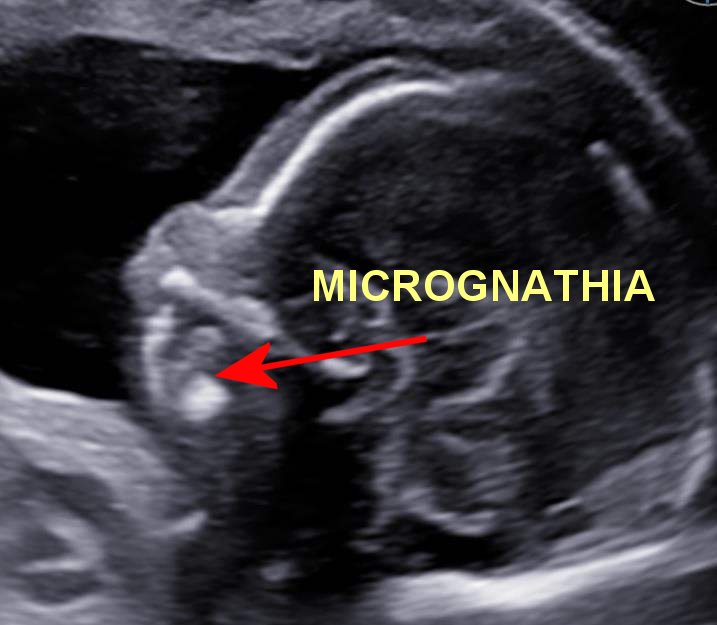
Micrognathia & retrognathia

Micrognathia refers to a small mandible, while retrognathia emphasizes posterior positioning of the chin relative to the maxilla. These may be isolated, syndromic, or associated with skeletal dysplasias or CNS anomalies.

Sonographic features

  • Mid-sagittal profile view shows recessed chin and steep facial profile.
  • Inferior facial angle reduced compared to normal reference values.
  • Polyhydramnios may be present due to impaired swallowing in more severe cases.
Micrognathia sagittal profile schematic
Mid-sagittal face profile with receding chin consistent with micrognathia (schematic placeholder).

Associations

  • Pierre Robin sequence (micrognathia, glossoptosis, airway compromise; often with cleft palate).
  • Skeletal dysplasias and chromosomal syndromes.
  • Central nervous system anomalies affecting facial development and tone.

When micrognathia/retrognathia is suspected, evaluation extends to spine, limbs, chest, and CNS, along with consideration of genetic counseling and airway planning for delivery in severe cases.

Craniosynostosis (craniosynostoses): patterns, key syndromes, and prenatal ultrasound clues

Craniosynostosis is premature fusion of one or more cranial sutures, producing a characteristic head shape and (in some syndromes) midface/orbital abnormalities. Prenatal recognition is most often triggered by abnormal skull shape on the axial head view and/or abnormal head biometry trends, and can be supported by 3D/4D evaluation of sutures when available.[1][2]

Best “screen” window: 18–24 w Often clearer on follow-up: 24–32 w High suspicion: cloverleaf / severe turricephaly

General ultrasound approach

  1. Confirm head shape in multiple planes (axial BPD/HC plane + coronal + mid-sagittal profile). Document asymmetry and frontal contour.
  2. Trend head indices (HC, BPD, OFD, cephalic index) if suspicion is mild/subtle; progressive deviation may be the earliest clue in single-suture synostosis.[3][4]
  3. Target the sutures with 3D/4D (if available) to look for absent suture gap / ridging and to explain an “unusual” skull contour.[2]
  4. Look beyond the skull: orbits (proptosis/shallow orbits), midface hypoplasia, hands/feet (syndactyly, broad thumbs/toes), ventriculomegaly/hydrocephalus, airway/choanal issues, and other anomalies.[1]
  5. Escalate evaluation if suspected: detailed anatomy + consider fetal MRI for cranial sutures/brain and palate in selected cases.[1]

Single-suture patterns (high-yield recognition)

Pattern (suture) Classic head shape clue Ultrasound findings / tips Notes / genetics
Metopic synostosis (metopic) Trigonocephaly: triangular/“keel” forehead, frontal narrowing; may have apparent hypotelorism Narrow/pointed frontal contour on axial/coronal views; assess interorbital distance and forehead shape. 3D surface rendering can help demonstrate forehead contour. Often sporadic; can be syndromic in some settings. (Many centers use imaging + genetics selectively based on associated anomalies.)[5][6]
Unicoronal synostosis (one coronal) Anterior plagiocephaly: asymmetric forehead/orbit; “harlequin” orbit postnatally Asymmetric frontal contour; orbital asymmetry; facial asymmetry. Evaluate ears, orbits, and midface. Consider whether this is isolated vs a coronal-synostosis syndrome. Can be isolated or syndromic (e.g., Muenke, Saethre-Chotzen).[7][8]
Sagittal synostosis (sagittal) Scaphocephaly: long, narrow skull (dolichocephaly) Progressive reduction in cephalic index across the second half of pregnancy is a practical clue; consider targeted 3D evaluation of sutures when CI trends down.[3][4] Often isolated/sporadic; evaluate for associated anomalies if any red flags.

Syndromic craniosynostosis (Apert, Crouzon, Pfeiffer, Muenke, Saethre-Chotzen)

The goal at ultrasound is often not to “name” the syndrome immediately, but to recognize the pattern (coronal/multisuture + midface/orbits + limb findings) and trigger an appropriate diagnostic pathway (targeted gene/panel testing, fetal MRI, multidisciplinary counseling).

Condition Key prenatal ultrasound clues Genetics (typical) Distinguishing notes
Apert syndrome
  • Coronal (often bicoronal) ± multisuture craniosynostosis → brachy/turribrachycephaly; abnormal frontal contour
  • Symmetric syndactyly (“mitten” hands; fused central digits), sometimes easier with 3D
  • Midface retrusion; possible cleft palate; polyhydramnios may occur
FGFR2, autosomal dominant; many cases de novo.[9] “Hands + skull” combination is the classic prenatal trigger.[10]
Crouzon syndrome
  • Craniosynostosis (often coronal/multisuture) with brachycephaly/turricephaly
  • Proptosis/shallow orbits may be appreciable; midface hypoplasia
  • Usually no hand/foot anomalies (helps separate from Apert/Pfeiffer)
Most commonly FGFR2, autosomal dominant (variable expressivity).[11] Familial cases may be suspected on subtle brachycephaly + proptosis on 2D, aided by 3D surface rendering.[12]
Pfeiffer syndrome
  • Multisuture craniosynostosis; severe forms may show cloverleaf skull
  • Midface hypoplasia; proptosis
  • Broad, medially/radially deviated thumbs and great toes; variable syndactyly
FGFR2 and FGFR1, autosomal dominant; many severe cases are de novo.[13] “Cloverleaf skull + broad thumbs/toes” is a classic high-suspicion prenatal pattern.[14]
Muenke syndrome
  • Coronal craniosynostosis (uni- or bilateral) → anterior plagiocephaly or brachycephaly
  • Mild hand/foot abnormalities may be present (often subtle on prenatal imaging)
FGFR3 p.Pro250Arg (P250R), autosomal dominant.[7][15] Often milder/variable; consider when coronal synostosis is identified and the rest of anatomy is near-normal.
Saethre-Chotzen syndrome
  • Coronal synostosis (often) → anterior plagiocephaly/brachycephaly; facial asymmetry
  • Ptosis/low frontal hairline and small external ear anomalies may be present (variable)
  • Mild limb findings can occur (e.g., partial syndactyly)
TWIST1, autosomal dominant (haploinsufficiency).[8] Prenatal recognition has been reported in familial/high-risk pregnancies using skull-shape cues and 3D rendering.[16]

Practical reminders for the differential

  • Coronal / multisuture + hand syndactyly → think Apert (FGFR2) bucket.[9]
  • Coronal / multisuture + proptosis, no limb anomalies → think Crouzon (FGFR2) bucket.[11]
  • Cloverleaf skull ± broad thumbs/toes → think Pfeiffer (FGFR2/FGFR1) bucket.[13]
  • Unicoronal / mild phenotype → consider Muenke (FGFR3 P250R) and Saethre-Chotzen (TWIST1).[7][8]
  • Isolated skull-shape change (metopic/sagittal) → focus on pattern, trends, and associated anomalies; add 3D suture evaluation if available.[1][2]
Genetic testing note (quick, practical)

When craniosynostosis is suspected on ultrasound, many centers consider: chromosomal microarray when multiple anomalies are present, and targeted craniosynostosis gene testing (e.g., FGFR2/FGFR3/FGFR1/TWIST1) or a broader panel/exome depending on the pattern and family history. (Local practice varies; coordinate with genetics.)
Midline facial anomalies & holoprosencephaly spectrum

Midline facial anomalies often parallel the severity of underlying forebrain maldevelopment in holoprosencephaly. Recognition of these patterns is important when imaging both the CNS and face.

Severe anomalies

  • Cyclopia and synophthalmia:
    • Single orbit or closely spaced, fused orbits.
    • Absent or abnormal nose; may have proboscis above the orbit.
  • Ethmocephaly:
    • Hypotelorism with proboscis situated between closely set orbits.

Moderate and subtle expressions

  • Midline clefts of lip and/or palate.
  • Hypotelorism without extreme orbital fusion.
  • Flat midface and nasal bridge abnormalities.

These facial findings should prompt careful review of the CNS for holoprosencephaly spectrum abnormalities (see CNS module) and evaluation for chromosomal and single-gene etiologies (e.g., trisomy 13).

Facial and CNS anomalies are often concordant; midline facial findings can provide additional prognostic information when counseling about holoprosencephaly and related malformations.

Neck masses, cystic hygroma & lymphatic malformations

Neck and nuchal abnormalities include cystic hygroma, lymphatic malformations, teratomas, and fetal goiter. These can be associated with aneuploidy, structural anomalies, and hydrops.

Cystic hygroma

  • Multiloculated, septated cystic mass, typically in the posterior neck region.
  • May extend laterally and anteriorly; can be associated with generalized edema and hydrops.
  • Strong association with chromosomal abnormalities (e.g., Turner syndrome, trisomies).
Cystic hygroma neck schematic
Posterior neck cystic hygroma with septations

Lymphatic malformations & other neck masses

  • Lymphatic malformation:
    • Unilocular or multilocular cystic lesion in the neck or face.
    • May extend into mediastinum or axilla.
  • Fetal goiter:
    • Symmetric or asymmetric anterior neck enlargement replacing the normal thyroid region.
    • Often associated with maternal thyroid disease or treatment.
  • Teratomas and other solid masses:
    • Complex, solid-cystic masses; may cause airway compromise and polyhydramnios.

Large neck masses can interfere with swallowing and airway patency, increasing risk for polyhydramnios, preterm birth, hydrops, and delivery complications. Multidisciplinary planning is recommended when significant airway compromise is suspected.

Nuchal region & soft markers

The nuchal region is important both for first-trimester nuchal translucency (NT) and second-trimester nuchal fold thickness, which serve as soft markers for aneuploidy.

Nuchal translucency (first trimester)

  • Measured in mid-sagittal plane at 11–13+6 weeks.
  • Increased NT is associated with chromosomal abnormalities and certain structural anomalies.

Nuchal fold thickness (second trimester)

  • Measured in the transverse view of the head at the level of the CSP and cerebellum.
  • Values above threshold (commonly ≥ 6 mm between 15–20 weeks) are considered a soft marker for trisomy 21.
See dedicated NT & soft marker tools
Ears & minor craniofacial soft markers

Ear morphology and position can provide additional clues to syndromes and aneuploidy, although routine measurement is not universally performed in all Level II examinations.

Ear position & size

  • Low-set or posteriorly rotated ears are described in numerous syndromes.
  • Microtia can be part of craniofacial microsomia or other malformation sequences.

Other subtle markers

  • Facial asymmetry.
  • Abnormal nasal bridge contour.
  • Minor jaw or orbital disproportions without frank malformation.

These minor findings are interpreted in the context of the overall anatomic survey and prenatal screening results. Isolated, subtle variants often have minimal clinical impact, whereas multiple soft markers or major anomalies may prompt genetic evaluation.

References

Key references and practical sources for fetal face/neck imaging and craniosynostosis (links open externally). Reference markers in the craniosynostosis section correspond to the numbered items below.

  1. Mak ASL, et al. Prenatal ultrasonography of craniofacial abnormalities. Ultrasonography. 2018.
  2. Benacerraf BR, et al. Three-dimensional ultrasound to detect craniosynostosis (demonstration of fused sutures and abnormal face). Ultrasound Obstet Gynecol. 2000.
  3. Constantine S, et al. Sonographic indicators of isolated fetal sagittal craniosynostosis. Ultrasound Obstet Gynecol. 2020.
  4. Constantine S, et al. The antenatal diagnosis of isolated sagittal craniosynostosis (cephalic index trend). J Obstet Gynaecol. 2019.
  5. Betances EM, et al. Craniosynostosis (overview). StatPearls. 2023.
  6. Fernández-de Thomas RJ, et al. Trigonocephaly (metopic synostosis). StatPearls. 2023.
  7. Kruszka P, et al. Muenke Syndrome. GeneReviews. Updated 2023.
  8. Gallagher ER, et al. Saethre-Chotzen Syndrome. GeneReviews. Updated 2019.
  9. Wenger TL, et al. Apert Syndrome. GeneReviews. Updated 2019.
  10. David AL, et al. Diagnosis of Apert syndrome in the second trimester using 2D ultrasound. Prenatal Diagnosis. 2007.
  11. Conrady CD, et al. Crouzon Syndrome. StatPearls. 2023.
  12. Jindal A, et al. Prenatal diagnosis of Crouzon syndrome by subtle 2D ultrasound findings (brachycephaly + proptosis). Ultrasound Obstet Gynecol. 2019 (abstract).
  13. Das JM, et al. Pfeiffer Syndrome. StatPearls. 2023.
  14. Torres-Canchala L, et al. Prenatal diagnosis of Pfeiffer syndrome (FGFR2 variant) — case report. Case Reports in Obstetrics and Gynecology. 2020.
  15. The Fetal Medicine Foundation. Craniosynostosis (including Muenke syndrome summary and FGFR3 testing note).
  16. Gebb J, et al. Prenatal sonographic diagnosis of familial Saethre-Chotzen syndrome. J Ultrasound Med. 2011.
Show expanded citation notes

Technique. 3D/4D (surface rendering + skeletal mode when available) can help demonstrate sutures and explain unusual head shape patterns, especially when 2D findings are subtle.

Clinical reality. Prenatal detection is commonly prompted by skull shape; single-suture forms can be subtle and may “declare” over time, so trends (e.g., cephalic index) can matter.

If you want, I can reformat the craniosynostosis references to match your preferred Perinatology.com style (e.g., PMID-first, journal abbreviations, and consistent link placement).